Why General-Purpose AI Struggles to Understand Cats
A cat is crouched beneath a dining chair. Her ears point sideways and her eyes are wide. Ask a general image model what she is feeling and it may answer, confidently, that she is afraid.
That could be right. She could also be tracking a toy, listening to a sound behind her, avoiding another cat, or preparing to jump onto the seat. The pixels show a posture. They do not supply the missing history.
This is the central problem with using general-purpose AI for feline behavior: fluent descriptions can arrive before the evidence is good enough to support them.
A label is easy to produce and hard to check
General vision-language models are trained to discuss an enormous range of images. They can usually identify a cat, a chair, and a food bowl. Feline behavior asks for a finer reading:
- Is the body loose, compressed, or shifted away from something?
- Are the ears flattened, rotated toward a sound, or moving independently?
- Is the tail still, wrapped, upright, or moving quickly?
- What was the cat doing immediately before and after this frame?
Veterinary behavior research describes the same difficulty. A domestic cat has a finite set of visible behaviors, and the same behavior can occur under different emotional motivations.[2] An ear position or crouch is therefore evidence, not a diagnosis.
A useful system should let a person inspect how it reached an interpretation. “The cat looks anxious” hides that path. “The cat is crouched, ears rotated back, body angled away from a nearby person” keeps the visible observations on the table.
Cats rarely give us one decisive signal
People often learn cat body language as a phrasebook: upright tail means friendly, flattened ears mean scared, slow blink means trust. These shortcuts are helpful until the situation changes.
Consider stillness. A cat can remain still while sleeping, watching prey, hiding, guarding a route, or experiencing pain. Tail movement can accompany play, irritation, balance, or concentrated tracking. Even purring can occur in more than one physical or emotional state.
Context narrows the possibilities. Body posture, ears, tail, face, action, nearby animals, access to hiding places, and recent routine all contribute. The home matters too: feline environmental guidelines connect a cat's comfort with its physical surroundings, social interactions, health, and behavior.[3]
This is why a single confident adjective is usually less useful than a short, structured record of what can be seen.
What feline-specific training changes
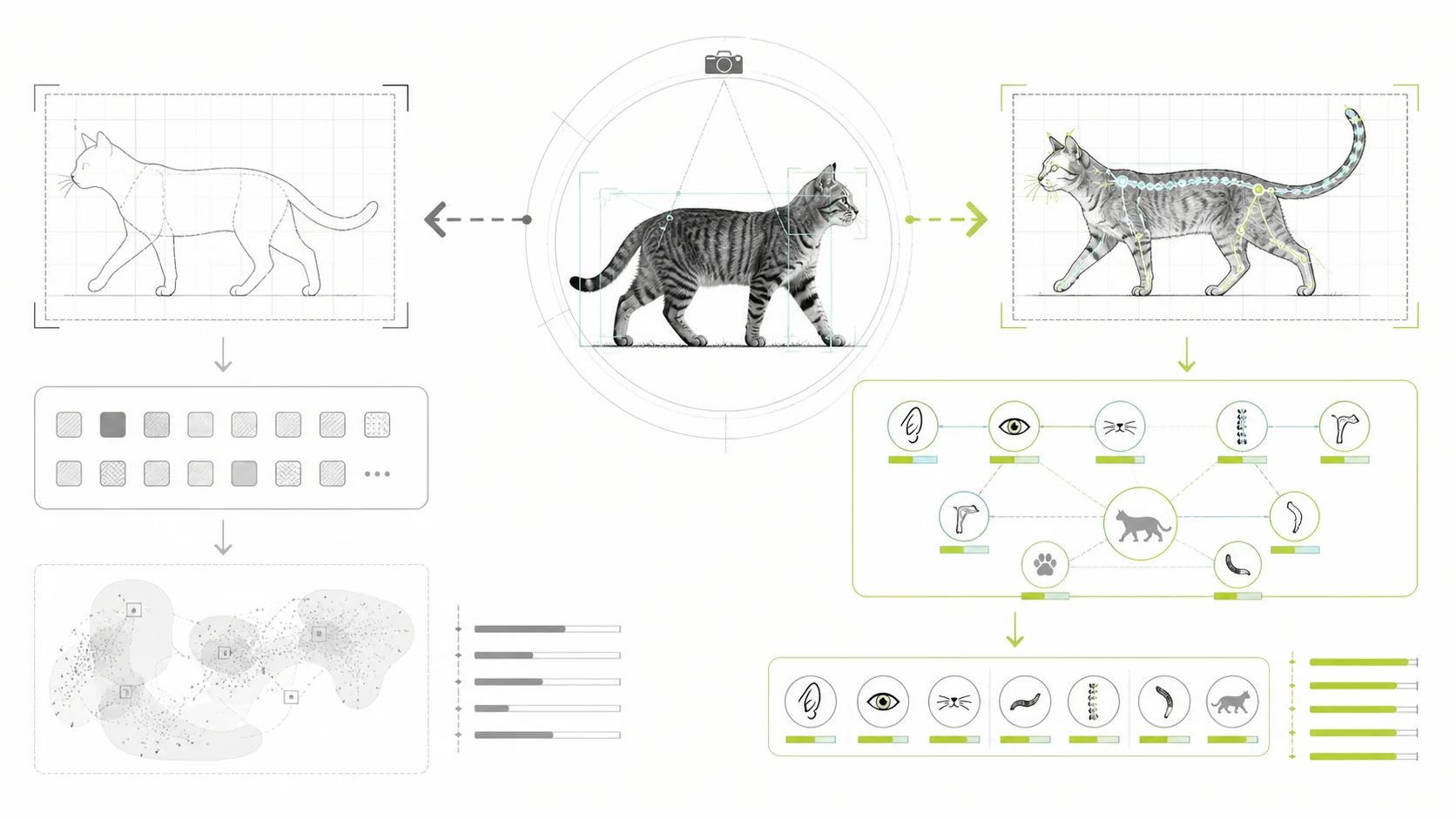
Our 2026 preprint takes that evidence-first approach. Catellect-VL-2B is trained to return structured fields for cat presence, action, posture, ears, tail, face, fur, interactions, and environmental anomalies.[1]
The accompanying benchmark contains roughly 40,000 image-behavior samples. About 38,000 instances are used across the training stages and 2,000 are held out for testing. On that held-out set, the full structured-output model reached 83.63% average accuracy across the reported behavior fields; the compact edge-oriented version reached 80.62%.[1]
Those are research results on a defined benchmark. They do not mean the model can read a cat's mind, diagnose illness, or interpret every home scene correctly. They show that a small model trained around feline-specific fields can be evaluated on something more demanding than whether its caption sounds plausible.
The difference is visible in the output:
| Fast conclusion | Inspectable observation |
|---|---|
| “Your cat is frightened.” | “Body crouched; ears rotated back; tail close to body; facing away from a nearby person.” |
| “Your cat is relaxed.” | “Body loose; eyes partly closed; ears neutral; resting in a familiar location.” |
The second column still needs interpretation. It simply gives that interpretation a firmer starting point.
One frame cannot tell the whole story
Even a careful visual model sees only the moment it receives. At home, the question owners care about is often temporal: is this different for my cat?
A new hiding place matters more when the cat has also stopped visiting the kitchen. A lower tail position matters more when it appears repeatedly during a particular interaction. A long nap may be ordinary at 3 p.m. and unusual during a cat's normal play period.
This is where individual baselines and multiple signals become useful. Images can describe the visible scene. Wearable motion, sound, location in the home, and routine can help explain when the scene occurred and whether it represents a change. None of those signals is definitive alone.
What Catellect should say with confidence
Catellect can make a narrower, more useful claim than “AI understands your cat.” It can help organize visible cues and changes in routine so an owner has something concrete to review. It can surface a pattern worth checking and make it easier to describe that pattern to a veterinarian.
It should also show uncertainty. A partially hidden tail should remain unknown. A single ambiguous frame should not become an emotional verdict. Health-related changes should lead to observation and appropriate veterinary care, not an automated diagnosis.
That restraint is part of the technology. Better feline AI will come from clearer evidence, better context, and conclusions that stay within what the system actually observed.
Sources
[1] Catellect-VL-2B: A Vision-Language Model for Edge-Based Feline Behavior Understanding
[2] Recognising and assessing feline emotions during the consultation
[3] AAFP and ISFM feline environmental needs guidelines
FAQ
Can AI tell exactly what a cat is feeling?
No. AI can organize visible signals and find patterns associated with different states. The same signal can still have several explanations, so context and a cat's individual baseline matter.
Why is normal image recognition not enough?
Object recognition answers “what is in the image?” Feline behavior work must distinguish subtle combinations of posture, body-part cues, actions, interactions, and environment.
Can this replace a veterinarian or behaviorist?
No. It can help an owner notice and document changes. Medical diagnosis and behavior treatment require professional assessment.