What Is Multimodal Feline Behavior Understanding?
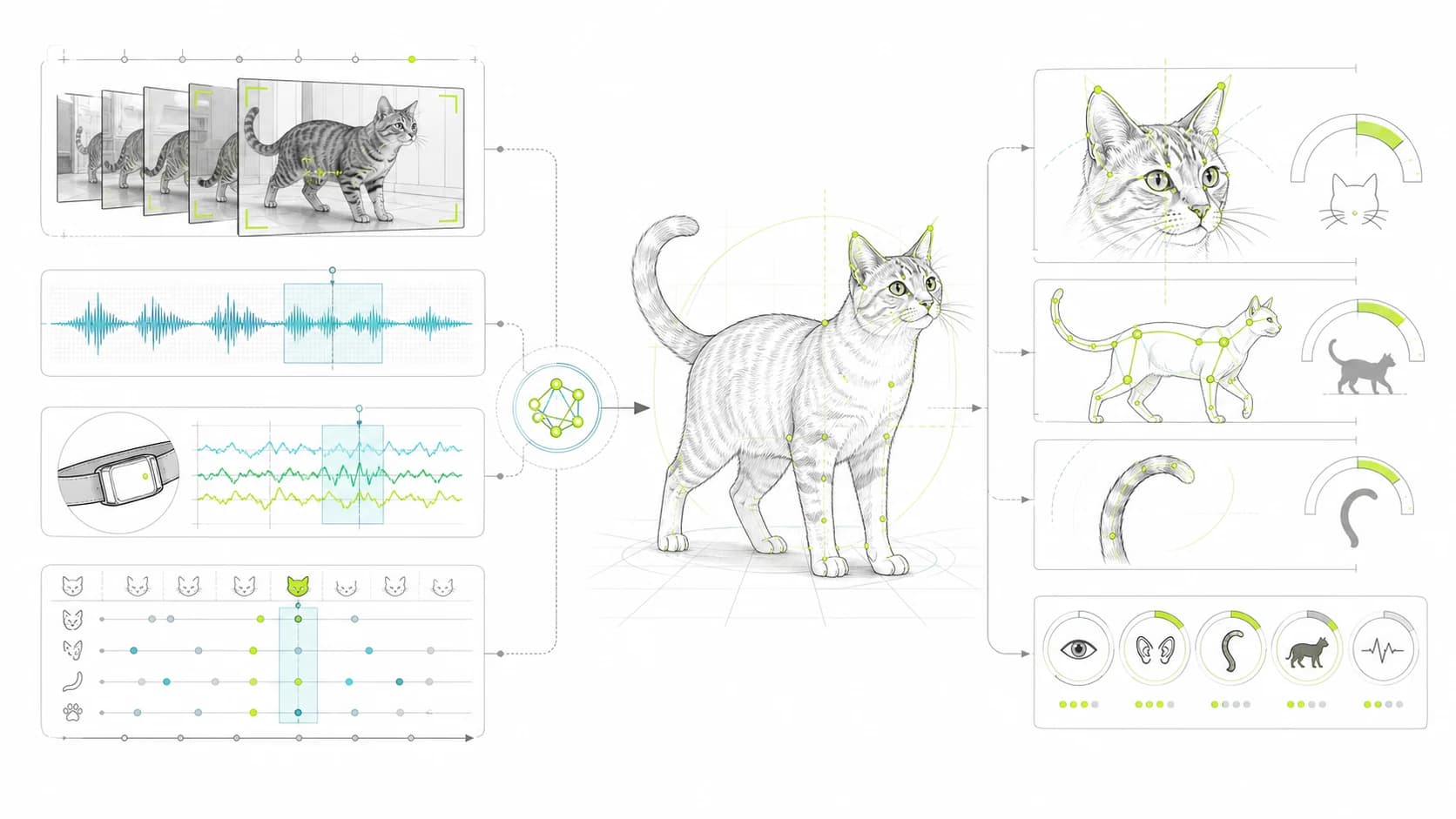
Suppose a collar reports that a cat was unusually inactive during the afternoon. That is useful, but incomplete. A camera might show that the cat spent the same hours sitting upright at a window. Audio might capture construction outside. The cat's history might show that this window is a normal resting place, while the noise is new.
Multimodal feline behavior understanding is the practice of bringing those signals together. Its job is not to collect everything. Its job is to reduce the number of assumptions required to explain a change.
Each signal answers a different question
“Multimodal” sounds technical, but the idea is familiar. People already combine what they see, hear, and remember when deciding whether a cat seems normal.
| Signal | What it can add | What it cannot settle alone |
|---|---|---|
| Camera | Posture, visible action, interactions, location in the scene | What happened outside the frame |
| Wearable motion | Continuity of movement, rest, bursts of activity | Why the movement occurred |
| Audio | Vocal events and changes in the sound environment | Which animal made every sound or what it meant |
| Home context | Room, time, nearby people or animals, environmental change | The cat's internal state |
| Individual history | A comparison with this cat's normal rhythm | A medical cause |
The value comes from agreement and disagreement between signals. If motion falls while video shows deep sleep in a usual spot, the record may be ordinary. If motion falls while the cat repeatedly crouches near the litter box and abandons meals, the same activity number deserves a closer look.
Owners want an explanation, not another chart
The local Reddit material we reviewed makes this clear. One owner bought a tracker after losing another cat in a road accident. Their questions were not about the sensor's sampling rate. They wanted to understand where the cat went, when location history updated, and whether sleep data would still be available while they were away.[4]
That is the gap between measurement and understanding. A device can record a number correctly and still leave the owner asking what happened.
Good multimodal design should turn data into a short chain of evidence:
- Activity was lower than this cat's usual afternoon level.
- Most of the period was spent in one familiar resting place.
- No unusual vocal or litter-area events were detected.
- The pattern returned to normal by evening.
The owner can inspect those statements. The system does not need to invent a mood to make the record useful.
Context helps with ambiguous feline signals
Cats reuse the same visible and audible signals in different situations. Veterinary behavior literature notes that the same behavior can arise from different emotional systems.[2] A multimodal record cannot remove that ambiguity, but it can narrow it.
A crouch during play looks different when it is followed by a chase and loose movement. A crouch beside a carrier after a stressful trip belongs to another context. Repeated nighttime vocalization means more when it is paired with roaming, disrupted sleep, or a change from the cat's previous routine.
Recent research in computational ethology is moving in this direction. Meow-Omni 1, for example, is a research model that combines video, audio, physiological time series, and text for feline intent tasks.[3] Our own work focuses on a different part of the problem: converting visual evidence into structured feline behavior fields that can be checked and processed efficiently.[1]
These are research systems, not proof that every modality should be active in every home.
Time is a modality too
A single measurement can say “low activity.” A timeline can say “activity has declined for five evenings, but only after a new pet entered the home.” That second statement is much closer to the question an owner needs to investigate.
Useful timelines preserve three things:
- Baseline: what is normal for this cat, in this home.
- Sequence: what changed first and what followed.
- Persistence: whether the pattern lasted minutes, days, or weeks.
This also protects against overreaction. One noisy night or one missed meal can have an ordinary explanation. A repeated change across movement, location, appetite-related routines, and social behavior is more informative.
More sensing should come with more restraint
Every additional sensor creates costs: power, bandwidth, storage, false alarms, and privacy risk. A thoughtful system decides what it needs before deciding what it can capture.
Continuous raw video is rarely the only option. Local processing can detect an event and keep a short, relevant clip. Low-resolution or derived signals may be sufficient for some tasks. Owners should be able to see what is recorded, what leaves the home, and how long it is retained.
Missing data should remain missing. If the cat is outside the camera view, the system should not fill the gap with a confident story. If two signals disagree, that disagreement is part of the result.
How this shapes Catellect
Catellect's direction is to combine the continuity of cat-worn sensing with the context available in the home, then compare both with the cat's own history. The product value is a readable account of change: what was observed, when it changed, and which evidence supports the alert.
That account can help an owner decide what to check next. It cannot determine a cat's private experience or provide a medical diagnosis. In a health concern, the useful output is a clear timeline and relevant clips or observations that an owner can share with a veterinarian.
Multimodal systems need to show their work. An extra sensor is worthwhile when it removes an assumption or fills a real gap in the timeline.
Sources
[1] Catellect-VL-2B: A Vision-Language Model for Edge-Based Feline Behavior Understanding
[2] Recognising and assessing feline emotions during the consultation
[3] Meow-Omni 1: A Multimodal Large Language Model for Feline Ethology
[4] Please someone give me an idiots guide to the Tractive!
FAQ
Does multimodal mean recording everything all the time?
No. It means using more than one relevant source of evidence. Event-triggered capture, local processing, and short retention can often answer the question with less data.
Is a camera or a smart collar more useful?
They answer different questions. A collar follows the cat and provides continuity; a camera can show posture, interactions, and room context within its field of view.
Does more data make an interpretation correct?
No. More data can reduce uncertainty when the signals are relevant and reliable. Poor-quality or contradictory inputs can also create more noise.