Wearables vs Ambient Sensing: What Does Each Tell Us About Behavior?
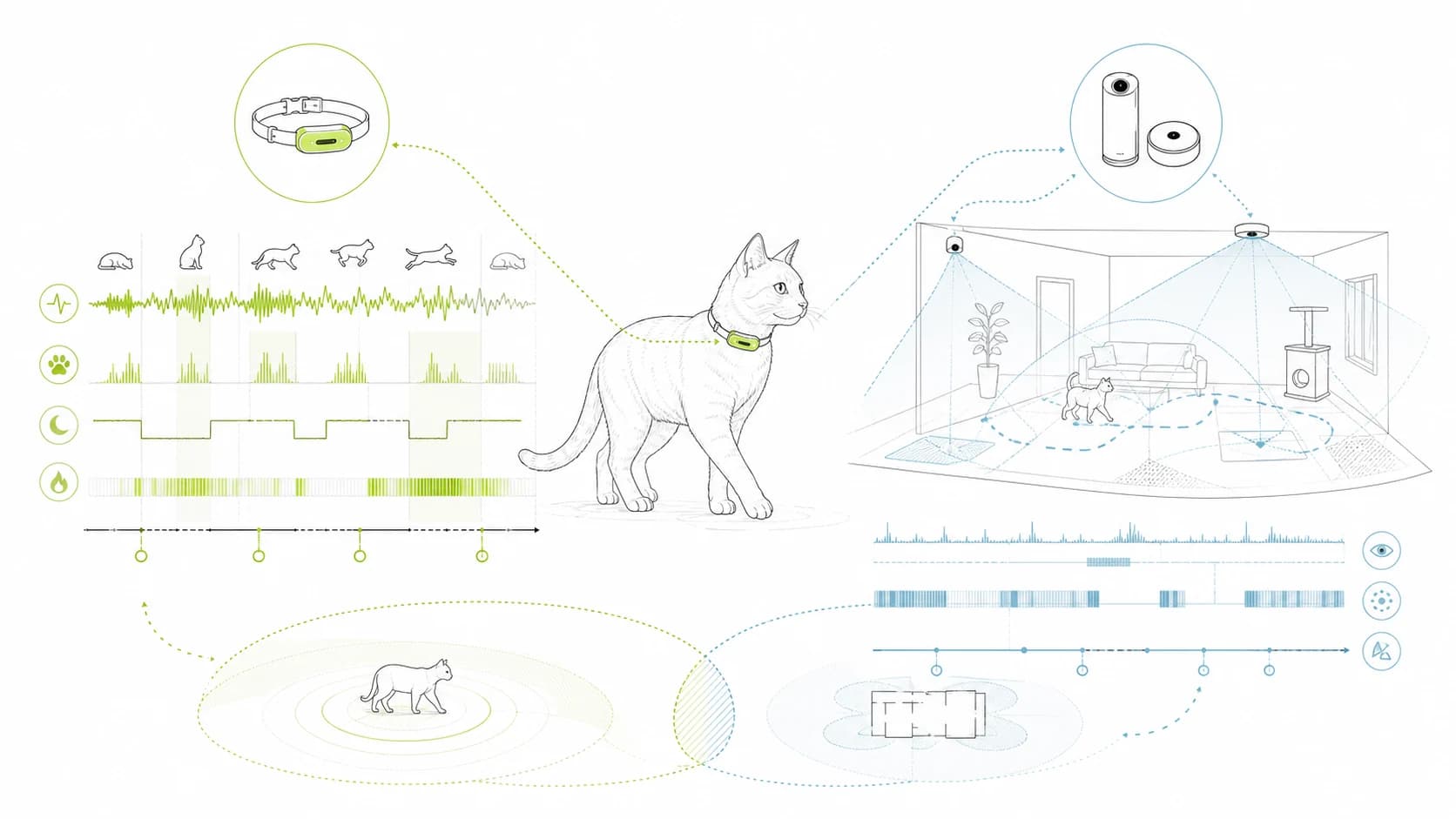
A collar can report a burst of movement at 2:14 a.m. A room sensor can show that the cat jumped from a shelf after another cat entered. Both records are accurate. Only one explains the scene.
Reverse the example and the tradeoff changes. Once the cat walks out of view, the room sensor loses the story while the wearable continues to follow the movement.
Wearables are good at continuity. Ambient sensing is good at context. The choice between them depends on the question you are trying to answer.
What a wearable knows
A wearable moves with the cat. Depending on its sensors, it may record motion, orientation, location, rest, or other time-series signals. That continuity is valuable when a cat moves between rooms, goes outdoors, or disappears beneath furniture.
It can help answer questions such as:
- When did activity begin and end?
- Was the movement brief or sustained?
- Did today's rhythm differ from this cat's usual day?
- Where did an outdoor cat travel, if location sensing is available?
The local tracker discussions we reviewed show how personal those questions are. One owner wanted location and sleep history while away from home after a previous cat had died in a road accident.[3] Another was trying to find a lost collar and needed a more precise distance than a broad location circle could provide.[4]
Those examples also expose the limits of a wearable. A motion spike does not reveal whether the cat was playing, fleeing, scratching, or being picked up. A location dot does not show posture, interaction, or the condition of the space. Hardware must also stay attached, remain comfortable, hold charge, and maintain a connection.
What an ambient sensor knows
Ambient sensors observe a place rather than a body. A camera in the living room can capture posture and interaction. A microphone can register a vocal event or a change in the sound environment. A litter-area or feeding-zone sensor can add location-specific context.
This can answer another set of questions:
- What was happening around the cat?
- Was another animal or person present?
- Which posture and body-part cues were visible?
- Did the event occur near food, water, a litter box, or a hiding place?
The environment is part of feline behavior, not background decoration. Clinical guidelines treat access to resources, safe places, vertical space, and social interaction as part of a healthy feline environment.[2]
An ambient sensor also has a hard boundary: its field of view. A camera cannot describe a cat behind the sofa, outside the room, or beyond a closed door. Multiple cats can make identity difficult. Lighting, occlusion, and furniture all affect what can be observed.
The practical difference
| Question | Wearable | Ambient sensing |
|---|---|---|
| Did activity change across the whole day? | Strong | Partial unless coverage is broad |
| What caused a sudden movement? | Usually unclear | Often visible within the scene |
| Was another cat nearby? | Limited | Often observable |
| What happened outside a room? | Continues with the cat | Loses coverage |
| What were the ears, tail, and posture doing? | Usually unavailable | Available when visible |
| What are the hardware tradeoffs? | Fit, battery, attachment, charging | Placement, coverage, privacy, network |
Neither column is the “smart” one. Each is incomplete in a different way.
When the signals disagree
Disagreement can be useful. Suppose a wearable reports low movement while a camera shows the cat sitting alert at a window for an hour. The collar is not wrong; motion was low. The video adds a reason not to equate low motion with sleep.
Or suppose the room camera shows no cat for most of the afternoon while the wearable reports ordinary activity elsewhere in the home. The missing video is a coverage gap, not evidence of inactivity.
A responsible system should preserve these distinctions. “No observation” is different from “nothing happened.” “Low movement” is different from “restful sleep.” Turning either into a stronger claim creates false certainty.
Combining them without collecting everything
The most useful combination is selective. A wearable can notice that a pattern changed, and an ambient device can look for relevant context. A room event can also provide a time marker for reviewing wearable data.
This does not require continuous cloud upload. Some detection can happen locally, with short event clips or derived signals retained only when they answer a clear question. Owners should know which sensors are active, what is stored, and what leaves the home.
The result should be a compact timeline, not a wall of charts:
Activity fell below the cat's usual evening range. The cat remained in a familiar hiding area for 48 minutes after a visitor arrived. Normal movement resumed later that night.
That record stays close to the evidence. It gives an owner something to check without claiming to know exactly how the cat felt.
How Catellect uses the distinction
Catellect is being designed around both kinds of evidence: continuity from the cat and context from the home. The research direction includes structured visual fields for posture, ears, tail, face, action, interaction, and environment.[1]
Product behavior must remain more conservative than a research demo. Sensor gaps, uncertain identity, hidden body parts, and conflicting signals need to be visible in the result. Health concerns should produce a useful record for the owner and veterinarian, not an automated diagnosis.
In practice, the system needs to notice a change, recover the relevant context, and show enough evidence for a person to decide what to check next.
Sources
[1] Catellect-VL-2B: A Vision-Language Model for Edge-Based Feline Behavior Understanding
[2] AAFP and ISFM feline environmental needs guidelines
[3] Please someone give me an idiots guide to the Tractive!
[4] My cat lost her collar and GPS once again. What do I do?
FAQ
Is a wearable better than a camera for cat monitoring?
A wearable is better for continuity across places. A camera is better for visible posture and scene context. The right choice follows the question and the home's constraints.
Can ambient sensors identify which cat caused an event?
Sometimes, when the animal is clearly visible and the system has a reliable identity signal. Occlusion, similar-looking cats, and poor lighting can make identity uncertain.
Do combined sensors need to upload continuous video?
No. Local event detection, short clips, and derived signals can reduce the amount of raw media retained or transmitted.