Cat Pain Face: How to Use the Feline Grimace Scale at Home
Direct Answer
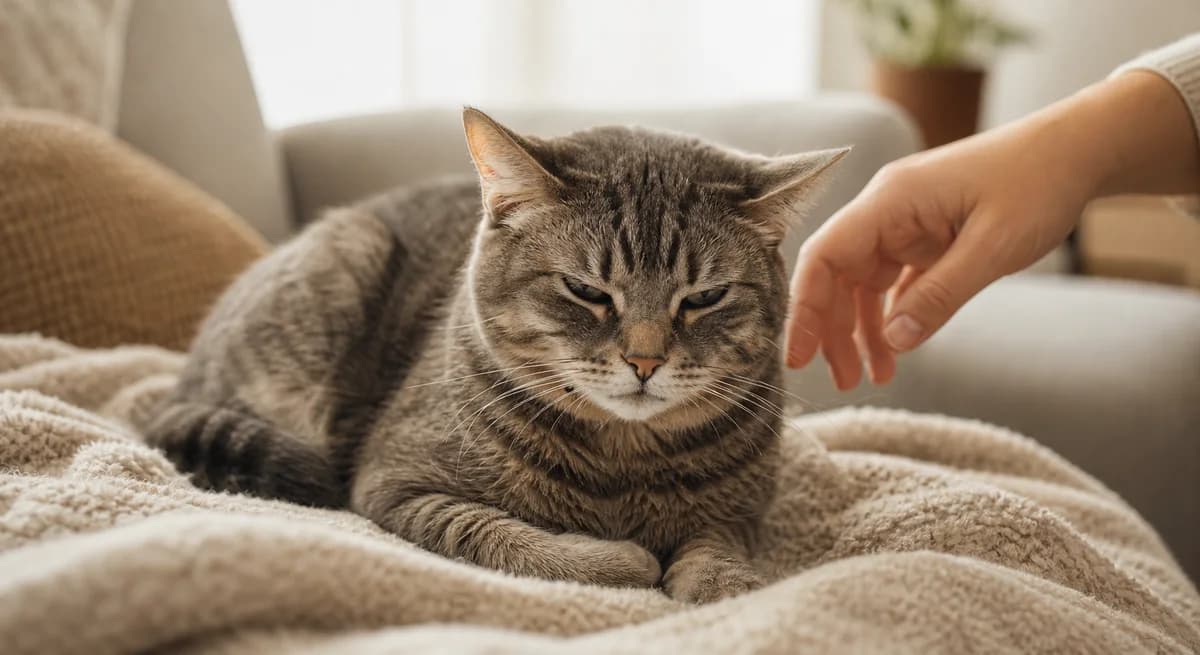
The Feline Grimace Scale is a practical way to screen for possible acute pain in cats by looking at five facial signals: ear position, orbital tightening, muzzle tension, whisker position, and head position. At home, it works best as an early-warning checklist: compare your cat’s face against their own relaxed baseline, record short videos, and contact a veterinarian when facial changes appear with appetite, mobility, litter box, or breathing changes.
This matters because cats often hide pain. In a Catellect review of cat-owner Reddit discussions, health and emergency questions showed up in about 74% of AskVet posts and 51.7% of CATHELP posts. Owners are asking for the same thing: a calmer way to decide when “my cat looks off” deserves action.
What Does the Feline Grimace Scale Look At?
The Feline Grimace Scale, often shortened to FGS, uses five facial action units. Researchers score each unit from 0 to 2, where 0 looks absent and 2 looks clearly present. Owners do not need perfect scoring. The useful question is simpler: does this cat’s face look different from their normal relaxed face?
| Facial signal | Possible pain cue | Common false alarm |
|---|---|---|
| Ears | Flattened, rotated outward, or pulled back | Fear, alertness, sudden sound |
| Eyes | Orbital tightening or a tense squint | Sleepiness, bright light, eye disease |
| Muzzle | Tension around the nose and mouth | Stress, strong smells, restraint |
| Whiskers | Stiff, straight, or pulled toward the face | Sniffing, hunting focus, curiosity |
| Head | Head held lower than usual | Dozing, relaxed loafing |
A single cue can be ambiguous. Several cues appearing together, especially with behavior changes, deserve more attention.
How to Use the Feline Grimace Scale at Home
-
Build a baseline first. Save a few photos or short videos of your cat when they are awake, relaxed, and healthy. Pain detection is easier when you can compare today with normal.
-
Watch in a quiet setting. Avoid scoring right after a fight, car ride, vet visit, intense play session, or loud household event.
-
Look for clusters. Facial tension matters more when it appears with hiding, reduced appetite, limping, litter box changes, restless sleep, or lower interaction.
-
Record video. A 15–30 second clip captures face, posture, gait, breathing, and response to people better than one photo.
-
Avoid painful touch tests. If your cat reacts strongly when touched, stop. A defensive bite or sudden escape is information for a vet, not a challenge to repeat.
When Should You Call a Vet?
Call a veterinarian promptly if facial pain cues appear with any of these red flags:
- Refusing food for 24 hours
- Straining to urinate or producing little urine
- Blood in urine
- Open-mouth breathing
- Repeated vomiting
- Marked lethargy or collapse
- Sudden limping or inability to jump
- Hunched posture that persists
- Aggression or panic when a specific body area is touched
The Feline Grimace Scale can suggest pain risk. It cannot identify the source of pain.
Why a Single “Pain Face” Is Not Enough
The FGS turns a vague feeling into specific observations, but it has limits. Cats can squint in bright light, flatten their ears from fear, or tense their muzzle during restraint. Some painful cats show only mild facial changes. The stronger question is: has this cat’s face changed from their baseline, and did other daily patterns change at the same time?
That is where a multi-signal approach becomes useful. A face cue becomes more meaningful when it lines up with lower activity, disrupted sleep, litter box changes, reduced appetite, less grooming, or avoidance of jumping.
A Simple Three-Step Pain Check
| Step | What to observe | What to record |
|---|---|---|
| Face | Ears, eyes, muzzle, whiskers, head position | Photo or 15–30 second video |
| Body | Hunched posture, slow walking, reduced jumping, fast breathing | When it started and what changed |
| Routine | Food, water, litter box, sleep location, social behavior | 24–72 hour pattern, not one moment |
If only one mild signal appears, record it and keep watching. If multiple signals appear together or persist, contact your vet with the video and notes.
How Catellect Helps Owners Recognize Pain Patterns Earlier
A cat pain face is useful because it gives owners a visible cue to pause and look closer. Changes in ear position, eye tension, whisker direction, muzzle shape, or head posture can make discomfort easier to discuss, especially for cats who hide pain well. Catellect can make that moment more actionable by pairing visible cues with the cat’s own daily baseline.
The stronger product promise is earlier pattern recognition. Catellect can track low-friction signals such as activity rhythm, sleep location, appetite-related routines, litter box timing, grooming-adjacent behavior, and interaction levels. When several of those signals drift together, an owner gets a clearer reason to check for pain, stress, illness, or environmental changes.
This also improves the quality of the owner-vet conversation. Instead of arriving with a vague concern like “my cat looks off,” the owner can bring a timeline: fewer playful moments, more hiding, lower activity, changed litter visits, reduced appetite cues, or repeated pain-face observations after jumping or being touched. Catellect’s role is to turn scattered daily observations into a readable pattern that helps owners act earlier and communicate with more confidence.
References
- Effects of feline personality on pain assessment with two validated behaviour-based scales: https://pmc.ncbi.nlm.nih.gov/articles/PMC12314223/
- An ethogram of acute pain behaviors in cats based on expert consensus: https://pmc.ncbi.nlm.nih.gov/articles/PMC10538801/
- Characterization of pain behaviors in kittens following ovariohysterectomy using video assessment: https://pmc.ncbi.nlm.nih.gov/articles/PMC12037879/
FAQ
Can the Feline Grimace Scale replace a vet exam?
No. It helps owners observe and document possible pain cues. Diagnosis still requires professional examination, history, and sometimes imaging or lab work.
What is the fastest way to check my cat’s pain face?
Compare today’s ears, eyes, muzzle, whiskers, and head position with a relaxed baseline photo. Then check whether appetite, movement, litter box use, and social behavior changed too.
Why does Catellect focus on trends?
Cats vary by age, personality, environment, and context. A single moment can mislead. A pattern that drifts away from an individual baseline is more useful for early alerts.
Related reading: