Why Your Cat Hides When Sick (And How Smart Tech Can Help)
"I kept dismissing my cat's hiding as 'just being grumpy.' She'd done it before during thunderstorms and after the movers came through. Turned out she had a dental abscess that had been developing for weeks. I felt so guilty for waiting. The vet said she was in significant pain. She'd been hiding from me to deal with it alone." — r/AskVet community member
That moment of realization — that your cat was suffering while you assumed everything was fine — is one of the most common and most painful experiences in cat ownership. It shows up across Reddit's cat communities again and again, in r/AskVet, r/CATHELP, r/Petloss, and r/cats.
It's not negligence. It's a fundamental mismatch between how cats communicate distress and what humans naturally recognize as "sick."
The Evolutionary Reason Cats Hide Illness
Cats are what ecologists call "solitary stalking predators." Unlike wolves or lions who hunt in cooperative groups, cats evolved to hunt alone. This means they also face threats alone — without a pack to defend them when they're vulnerable.
In the wild, a visibly sick or injured cat is a target. Other predators, territorial rivals, even scavengers — all of them key into behavioral cues of weakness. So over millions of years, cats evolved extraordinary capacity to suppress visible signs of pain and illness. Moving normally despite injury. Eating when they'd rather not. Appearing alert when they're exhausted.
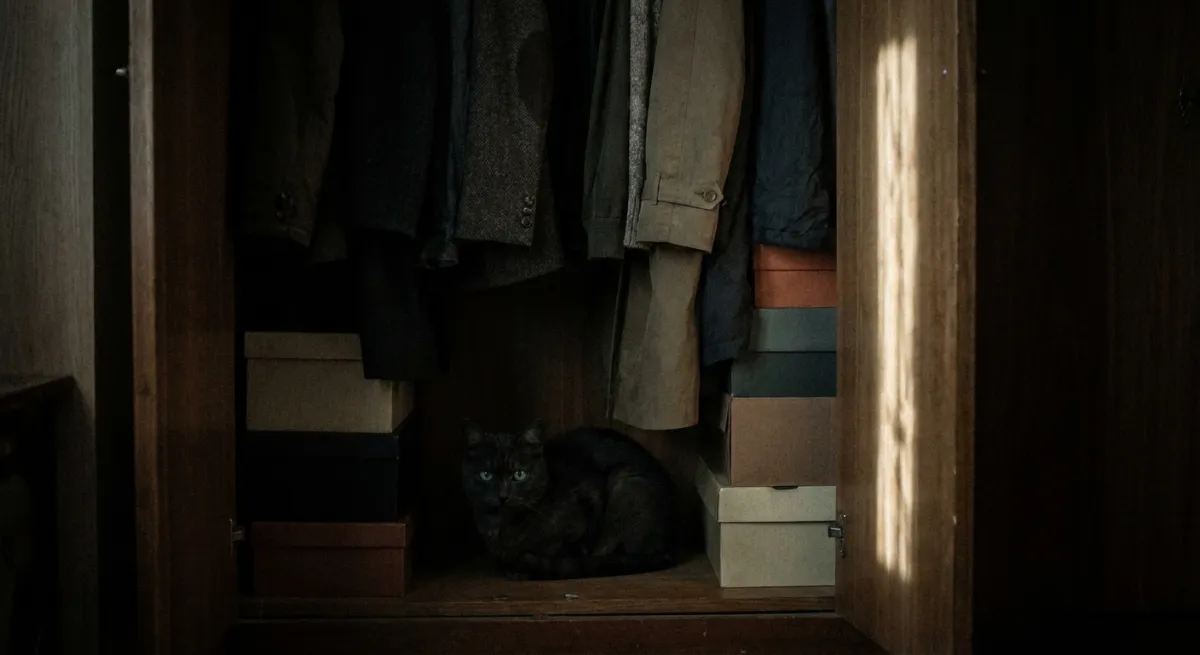
When this masking fails — when a cat can no longer maintain the performance of normalcy — they retreat. They find the darkest, most concealed, most defensible space available: under the bed, inside a closet, behind the washing machine. Somewhere small with their back protected, where they can see the entrance.
This is not behavioral. It's biological. It's ancient. And it's completely invisible to us unless we know what to look for.
Why Hiding Is a Medical Emergency (Sometimes)
Hiding for a few hours after a stressful event — a vet visit, a thunderstorm, a houseful of guests — is normal cat behavior. The concerning version is different:
Concerning hiding patterns:
- Persisting more than 24-48 hours with no obvious environmental trigger
- Cat refuses to come out for food or water
- Cat doesn't emerge to use the litter box
- Combined with other symptoms: lethargy, unusual sounds (or unusual silence), labored breathing
- Sudden hiding in a cat that's normally social and confident
- Hiding in unusual locations (a sick cat may hide in places they've never chosen before)
From our analysis of over 6,451 health-related Reddit posts, hiding that persists beyond 24-36 hours is among the top behavioral warnings that precede a confirmed diagnosis. The pattern is consistent across community after community: "My cat hid for three days and I thought she was just being moody. Then I found her collapsed."
What Conditions Cause Hiding?
Nearly any painful or debilitating condition can trigger the hiding response. The most common in Reddit case reports:
Pain Conditions
- Dental disease — The most commonly missed; affects 70-80% of cats over 3 years old
- Urinary obstruction (particularly male cats) — Life-threatening, requires immediate care
- Arthritis — Very common in older cats, very commonly missed
- Injury — Internal injury from falls or collisions may not be immediately obvious
- Pancreatitis — Extremely painful; cats with pancreatitis often hide intensely
Systemic Illness
- Kidney disease — Progressive; cats in early stages often show increased hiding
- Liver disease — Nausea and weakness drive hiding
- Hyperthyroidism — Paradoxically, some hyperthyroid cats become hyperactive, but others become withdrawn
- Respiratory infections — Upper and lower; cats who can't breathe comfortably seek quiet, still spaces
- Cancer — Pain and weakness; hiding is often an early sign
Neurological
- Feline cognitive dysfunction (dementia) — Disorientation drives hiding
- Vestibular disease — Sudden onset dizziness causes cats to retreat and stay very still
- Seizure aftereffects — Post-ictal cats often hide for hours
Emotional Causes
- Severe stress or anxiety
- Grief (yes, cats grieve the loss of companion animals and humans)
- Environmental threats (an outdoor cat visible through the window; changes in household dynamics)
The Detection Problem: You Have 8 Hours of Visibility at Best
Here's the structural problem: most cat owners are away from home for 8-10 hours daily. During those hours, their cat lives a completely parallel life — sleeping, moving through the house, using the litter box, eating, monitoring their territory.
If a cat begins hiding during work hours — retreating to a closet at 10am and emerging only briefly before the owner comes home at 6pm — the owner may see nothing unusual for days. The cat performs briefly when they return (animals instinctively mobilize when their person arrives), then retreats again.
"She was still coming for cuddles when I got home. I thought she was fine. Kidney disease, Stage 3. The vet said it had probably been going on for months." — r/CATHELP
This is the scenario that haunts cat owners — and it's structurally predictable given how monitoring typically works.
Traditional Ways to Monitor a Hiding Cat
Before we get to technology, the basics matter:
1. Establish a baseline Know your cat's normal hiding patterns. Some cats routinely spend time in concealed spots — under the bed after meals, in a closet at midday. Your concern is deviation from their normal, not from some abstract average.
2. Track eating and litter box use If your cat doesn't approach food for 24+ hours, that's a signal. If the litter box shows no use in 24 hours, that's a more urgent signal. Automatic feeders with sensors and self-cleaning litter boxes with digital activity logs make this monitoring easier.
3. Check on them calmly Don't force a hiding cat out of their refuge — it increases stress and may mask symptoms further. Instead, quietly approach, sit nearby, and observe from a distance. Is their breathing normal? Do they respond to your voice? Are they alert when they see you?
4. Offer food near their hiding spot A sick cat may not emerge for food but might eat a small amount if offered close by. This tells you they're alert enough to eat, which is meaningful clinical information.
5. Look for the cluster One sign in isolation might mean nothing. Hiding plus not eating plus lethargy plus unusual breathing = call the vet now.
How Smart Technology Changes the Detection Window
The emerging category of pet behavioral monitoring addresses the core problem directly: filling the detection gap that exists during the hours you're not home.
What smart monitoring can detect:
Unusual stillness in one location — If your cat's smart collar or home cameras show they haven't moved from a single corner of a room for 12 hours, that pattern is automatically flagged.
Changes from behavioral baseline — AI-powered systems learn what "normal" looks like for your specific cat. A cat who typically logs 4 hours of active movement per day, but has shown only 45 minutes for three consecutive days, surfaces as an anomaly — even if the cat "looks fine" when you come home.
Reduced activity trends — Gradually decreasing activity over days or weeks is often the earliest detectable sign of a developing illness. Humans can rarely perceive gradual trends; machines can track them effortlessly.
Room-level location patterns — Knowing that your cat spent 18 consecutive hours in a single room they rarely visit, with no visits to the food bowl or litter box, is actionable information.
"I wish I'd known something was off earlier. It was only after she was really sick that I started looking back at everything and realized — she'd been less active for weeks. I just didn't see it at the time." — r/Petloss community member
This is exactly the problem Catellect's system is built to solve. Our smart collar paired with home base station technology passively tracks your cat's movement, activity levels, and behavioral patterns throughout the day — building a personalized baseline and flagging deviations automatically. Not to alarm you about every small change, but to surface the patterns that deserve attention.
When You Find Your Cat Hiding: A Decision Guide
Monitor and observe (check back in 4-6 hours) if:
- There's an obvious recent stressor (vet visit, guests, thunderstorm)
- The cat responds to your voice
- The cat hasn't been hiding more than 6-8 hours
- No other symptoms visible
Call your vet today if:
- Hiding persists more than 24 hours without clear cause
- Cat is not eating or drinking
- Any additional symptoms present (labored breathing, crying, limping)
- Cat is over 10 years old (older cats deteriorate faster)
Go to emergency vet immediately if:
- Labored or open-mouth breathing
- No urination in 24 hours (especially male cats)
- Cat cannot stand or walk normally
- Unresponsive or barely responsive to stimulation
- Signs of pain: crying, guarding a body part, flinching at touch
Respecting the Hiding Cat: Don't Force It
One well-intentioned mistake: forcibly removing a hiding cat from their refuge.
When a cat is hiding due to illness or fear, their hiding spot is their coping mechanism. Removing them adds stress to an already compromised state. Instead:
- Sit quietly nearby
- Speak in a calm, low voice
- Let them choose to come to you when ready (if the timeline allows)
- Move food, water, and a small litter tray close to their location
Only override this when the situation is urgent — and then act decisively without hesitation.
The Bond That Makes Watching So Hard
The pain of realizing your cat was sick and hiding it from you is real. It's not a failure of love — it's a collision between human emotional intelligence and feline evolutionary strategy. Cats don't hide because they distrust you. They hide because the impulse is older than domestic life. Older than the relationship between cats and humans at all.
The best we can do is learn to see around their instinct — with observation, with knowledge, and increasingly with tools that extend our perception into the hours we can't be present.
See What Happens When You're Not Home
Catellect is building a continuous behavioral monitoring system for cats — designed to give you visibility into the hidden hours when your cat lives their parallel life, and flag the patterns that matter most for their health.
Join our waitlist to be among the first to know when we launch.
👉 Join the Catellect Waitlist at catellect.com
Related reading: