How to Tell If Your Cat Is Stressed: A Science-Based Guide
"We adopted this sweet boy last year from the Humane Society. He was very sick, mainly stress-induced because being in a cage really stressed him out. He had stomach issues, always pulling his hair out, etc. We travel a lot and aren't sure if bringing him would stress him out more or leaving him at home..." — r/cats user
This post landed in one of the most-discussed threads in our cat community dataset. It resonated because it captures something so many cat owners face: the invisible, pervasive problem of feline stress — and how poorly equipped we often are to recognize or address it.
That cat's stress was so severe it caused physical disease: gastrointestinal problems, psychogenic alopecia (stress-induced hair loss). And the owner, clearly a caring person, was still trying to figure out the basics.
Stress is the silent epidemic in domestic cat health. Let's address it properly.
Why Feline Stress Is Different (And Why It Matters So Much)
Cats experience stress very differently from dogs or humans. Two key differences matter:
1. Cats are neophobic by nature. Change is threatening. Cats evolved in relatively stable territories with familiar threats and resources. Their nervous systems are tuned to notice and be alarmed by anything new or different. What seems minor to us — new furniture, a visitor, a change in your work schedule — can trigger a genuine stress response in a cat.
2. Cats mask stress. The same evolutionary pressure that makes cats hide illness makes them hide fear and anxiety. A stressed cat doesn't necessarily pace, bark, or act out visibly. They might just look... normal. Until the stress accumulates and becomes illness.
This matters because chronic stress in cats is directly linked to serious health conditions:
- Feline lower urinary tract disease (FLUTD) — stress is a primary trigger
- Idiopathic cystitis — often stress-induced, no infection present
- Inflammatory bowel disease (IBD)
- Upper respiratory infections (stress suppresses immune function)
- Psychogenic alopecia (compulsive over-grooming)
- Hypertension
- Reduced lifespan
One veterinary study found that indoor-only cats experiencing chronic stress had significantly higher rates of FLUTD — the same condition that causes urinary blockages, one of the most common cat emergencies.
Understanding feline stress isn't just about your cat's happiness. It's about their physical health.
The Science of the Feline Stress Response
When a cat perceives a threat, their hypothalamic-pituitary-adrenal (HPA) axis activates, releasing cortisol and adrenaline. In the short term, this is adaptive — it prepares them to fight or flee.
The problem is what happens with chronic stress — a sustained low-level threat that never resolves. Chronic cortisol elevation:
- Suppresses immune function
- Disrupts gut motility (causing GI symptoms)
- Increases inflammation throughout the body
- Alters pain sensitivity
- Changes behavior
Cats living in environments with persistent stressors — multi-cat conflict, unpredictable schedules, insufficient resources — can be in a low-grade chronic stress state indefinitely. Many owners never realize it.
12 Signs Your Cat Is Stressed
Physical Signs
1. Overgrooming or Hair Loss Psychogenic alopecia is one of the clearest physical manifestations of feline stress. Look for symmetrical hair thinning or bald patches, particularly on the belly, inner thighs, or the strip down the spine. The cat grooms obsessively — often when you're not watching — as a self-soothing behavior.
2. GI Symptoms Without Clear Cause Stress disrupts gut function. Intermittent vomiting, diarrhea, or constipation without a dietary change or detectable illness often points to stress. Vets call this the "gut-brain axis."
3. Lower Urinary Tract Problems Straining, frequent small urinations, blood in urine, or inappropriate elimination in a cat who was previously litter-box reliable — in the absence of infection — is strongly associated with stress-induced cystitis.
4. Weight Changes Chronic stress can cause both weight loss (reduced appetite, increased metabolism) and weight gain (stress-eating, reduced activity). Any unexplained weight change warrants both a vet visit and a stress audit.
Behavioral Signs
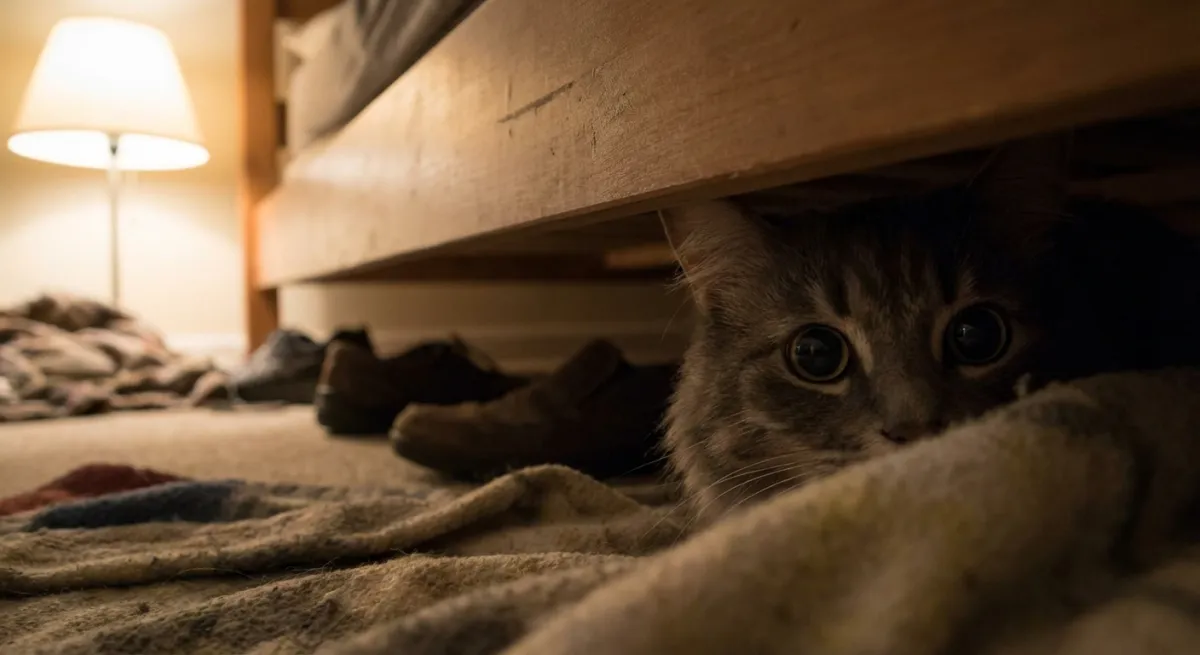
5. Hiding More Than Usual Withdrawal is the classic stress response. A cat who retreats to under-the-bed or in-the-closet more than their normal baseline is communicating distress.
6. Increased Aggression Redirected aggression — lashing out at you or another pet when they're actually reacting to an external stressor — is common and often misunderstood. "My cat randomly attacked me" is frequently a stress event with a trigger you didn't see.
7. Excessive Vocalization Crying, yowling, or unusual vocalizations beyond normal "talking" can indicate anxiety or distress.
8. Changes in Sleep Patterns Both excessive sleep (depressive withdrawal) and disrupted sleep (anxious hypervigilance) can indicate stress.
9. Reduced Play and Exploration Play behavior requires a baseline feeling of safety. A stressed cat often stops playing, stops exploring, and contracts their safe territory to a few square feet.
10. Increased Clinginess or Avoidance Stress can manifest as either extreme — desperately seeking contact with their person, or avoiding all interaction.
Posture and Body Language Signs
11. Tail Tucked or Carried Low A tail tucked under the body or pressed against the back legs indicates anxiety or submission.
12. Dilated Pupils, Flat Ears, Crouched Posture These are the classic "fear" posture signals. Pupils wide despite normal lighting, ears rotated back or flat, body low to the ground — your cat is frightened.
The Top Stress Triggers for Indoor Cats
Environmental Triggers
Multi-cat conflict The single most common stress source for indoor cats is competition with other cats. Even cats who "seem to get along" can create chronic low-grade stress through resource competition — one cat blocking access to food, water, litter boxes, or the owner's lap.
Resource crowding rule: provide one resource per cat, plus one extra (litter boxes, feeding stations, water bowls, resting spots).
Insufficient vertical space Cats are vertical animals. In the wild, elevation = safety. An apartment with no cat trees, shelves, or high perches deprives cats of a fundamental security resource. Stressed cats placed in high-vertical environments often visibly relax within days.
Loud or unpredictable environment Construction noise, parties, frequent visitors, young children, other pets — any unpredictable, high-intensity sensory input creates stress.
Litter box problems A litter box that's too small, too covered, in a high-traffic location, infrequently cleaned, or positioned where another cat can ambush at the entrance is a chronic stressor.
Schedule and Change Triggers
Changes in owner schedule Cats are deeply routine-oriented. Starting a new job, shifting from home to office work, irregular feeding times — these disrupt the predictability cats need to feel secure.
Moving or rearranging furniture New furniture alters the scent map of the home. Rearrangement eliminates familiar safe spots. Even major redecorating can stress sensitive cats for weeks.
New additions to the household A new pet, baby, or partner are significant stressors, especially when introductions happen abruptly.
Construction or renovation Noise, strangers in the home, disrupted spaces — renovation is a multi-stressor event.
Evidence-Based Ways to Reduce Cat Stress
1. Pheromone Therapy (Strong Evidence)
Feliway Classic (synthetic analog of feline facial pheromones) has the most clinical evidence of any non-prescription feline stress intervention. Multiple controlled studies show significant reductions in stress behaviors — hiding, aggression, inappropriate elimination — in cats exposed to the diffuser formulation.
Use: plug-in diffusers in rooms your cat spends most time in. Takes 1-2 weeks for full effect.
2. Enrich the Environment
- Vertical space: Cat trees, floating shelves, window perches
- Hiding spots: At least one enclosed hiding space per cat (cardboard boxes work perfectly)
- Window access: Watching the outdoors provides significant mental stimulation
- Foraging: Use puzzle feeders or scatter feeding to replace bowl-feeding; engages hunting instincts
3. Predictable Routines
Feed at the same times daily. Play at consistent times. Avoid sudden changes. Predictability is security for cats.
4. Proper Litter Box Setup
- One box per cat plus one extra
- Large, uncovered boxes (most cats prefer them)
- Clumping, unscented litter (most cats prefer fine-grained)
- Scooped daily, full change weekly
- Positioned in quiet, accessible locations with multiple exit paths
5. Play Therapy
Daily active play sessions using wand toys, laser pointers, or interactive puzzle toys are one of the most effective anxiety-reduction tools available. 10-15 minutes of active play twice daily can dramatically reduce stress-related behaviors.
6. Separate Resources in Multi-Cat Homes
Each cat needs their own: food station, water bowl, litter box, resting spot, and ideally their own "territory" within the home. Eliminate the need for competition.
7. Medical Intervention When Needed
For severe anxiety, veterinary options include:
- Gabapentin: Effective for acute situational anxiety (vet visits, travel, etc.)
- Fluoxetine (Prozac): For chronic anxiety disorders; requires weeks to take full effect
- Buspirone: Sometimes used for inter-cat aggression and anxiety
- Alpha-casozepine (Zylkene): Natural supplement with some evidence for mild anxiety
Always work with your vet before starting any medication.
The Monitoring Gap: How Smart Technology Helps
One of the core challenges with feline stress is that the most revealing behaviors happen when you're not watching. Overgrooming, hiding, reduced activity, pacing — these happen during work hours, overnight, in rooms you're not occupying.
Behavioral monitoring technology is beginning to fill this gap. AI-powered activity tracking can detect changes in a cat's daily behavior patterns — baseline activity levels, sleep quality, movement through the home — and flag deviations that suggest mounting stress before it manifests as physical illness.
This is particularly valuable because feline stress tends to be cumulative: small stressors pile up over weeks until the cat tips into crisis. Having continuous visibility into daily behavior patterns allows intervention at the accumulation stage rather than the crisis stage.
Catellect's smart collar and home monitoring system is designed precisely for this — building a behavioral baseline for your individual cat and surfacing changes worth investigating. It's the difference between reacting to symptoms and proactively maintaining wellbeing.
When to See a Vet
Seek veterinary evaluation if your cat shows:
- Any physical symptoms associated with stress (urinary issues, GI problems, skin/hair changes)
- Stress behaviors that don't respond to environmental modification within 2-3 weeks
- Sudden dramatic behavioral changes without an obvious environmental trigger
- Signs of severe anxiety (refusal to eat, leaving the home's safe areas entirely)
Many stress-related conditions have a strong behavioral component AND a medical component — treat both.
Your Cat Deserves a Calm Life
The research is clear: cats who live in low-stress environments are healthier, live longer, and have richer relationships with their owners. Most feline stress is preventable or manageable — once you know how to see it.
Start by evaluating your home environment, your cat's access to resources, and their daily routine. Then observe systematically. The subtle signs matter.
Know Your Cat's Stress Baseline
Catellect is building monitoring tools that help you understand your cat's behavioral rhythms — so you can catch stress signals early, before they become illness.
Join our waitlist for early access and updates.
👉 Join the Catellect Waitlist at catellect.com
Related reading: