Cat Separation Anxiety Is Real: Here's What the Research Says
"I work from home and recently had to start going to an office three days a week. My cat has started yowling when I leave, destroying things I've left on my desk, and vomiting. The vet says she's physically healthy. Is this... anxiety? Can cats even get that?" — r/CatBehavior user
Yes. Cats absolutely can get separation anxiety. And the post-pandemic shift back to offices has turned this from a niche concern into one of the fastest-growing discussion topics in cat communities.
Our analysis of over 105,000 Reddit posts found separation anxiety mentioned in 3,294 discussions — 13.2% of the entire dataset, and growing. For context, that's more posts than financial stress and close behind behavioral issues. This is not a small phenomenon.
Let's look at what the research actually says — and what you can do about it.
The "Cats Don't Need People" Myth
The cultural narrative around cats frames them as independent, aloof, and essentially indifferent to their human's presence. This myth persists despite decades of research suggesting otherwise.
What the science actually shows:
A landmark 2019 study at Oregon State University, published in Current Biology, tested cats using the Ainsworth Strange Situation Test — the same protocol used to measure attachment in human infants and dogs. Results: 65.8% of cats showed secure attachment to their primary caregiver. When their person left the room, cats with secure attachment showed stress; when they returned, behavior normalized.
A 2020 Italian study in PLOS ONE found that cats raised in human households develop what researchers call "social referencing" — they check in with their owners for cues about safety, much like infants check in with parents.
And a 2021 study found that cats distinguish their owner's voice from a stranger's voice and respond preferentially — even when they pretend otherwise.
The evidence is consistent: cats form genuine attachments. And when those attachments are disrupted — as they are when owners change routines, work longer hours, or start returning to the office — cats can suffer.
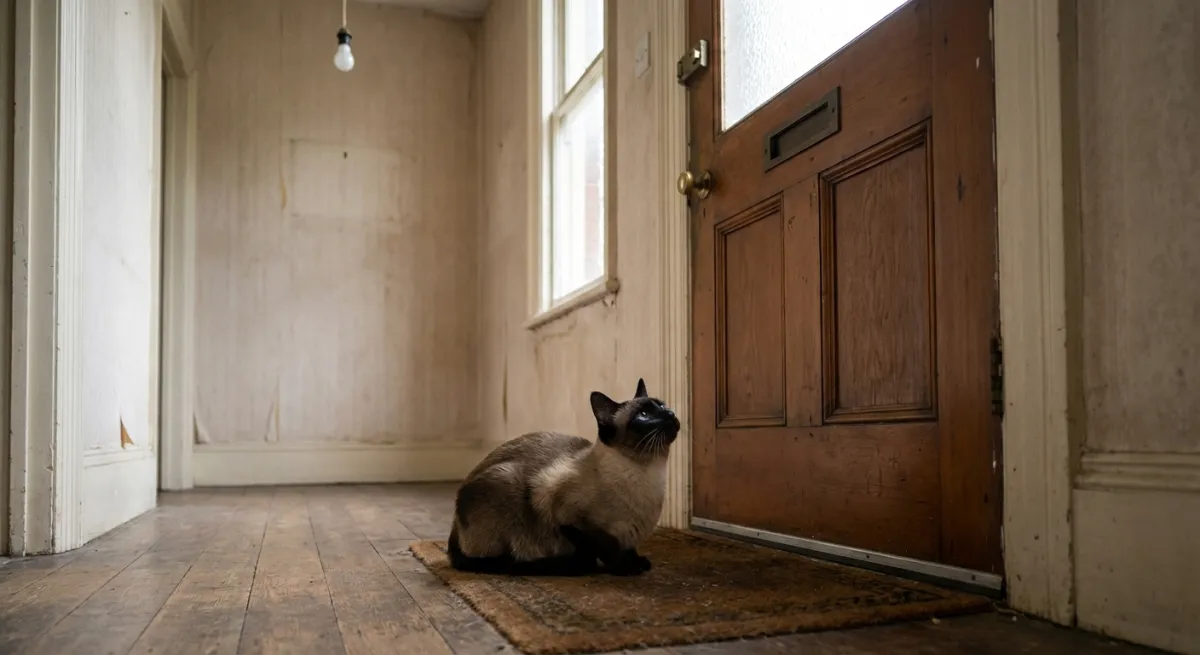
What Is Cat Separation Anxiety?
Separation anxiety in cats is a behavioral condition defined by distress responses specifically triggered by the owner's absence or anticipated departure.
It's distinct from general anxiety (which occurs regardless of the owner's presence) and from other behavioral problems with different causes.
The key feature: behaviors that occur when the owner is absent or leaving and resolve when the owner returns.
Signs of Separation Anxiety in Cats
Before You Leave
- Following you from room to room more intensely than usual (not just normal "shadow cat" behavior — this is anxious following)
- Vocalizing when they see you preparing to leave (picking up keys, putting on shoes, getting a bag)
- Attempting to block your exit
- Excessive rubbing or scent-marking on you
- Hiding before you leave (a counterintuitive pre-emptive withdrawal)
When You're Gone
- Destructive behavior: Knocking things off surfaces, scratching beyond normal, moving or chewing objects you've used
- Inappropriate elimination: Urinating or defecating outside the litter box — particularly on your belongings (clothing, bed, couch where you sit)
- Excessive vocalization: Neighbors may report this; you may hear it on cameras or smart monitors
- Reduced eating: Some anxious cats won't eat until their owner returns; others eat everything compulsively
- Vomiting or diarrhea: Stress activates the gut-brain axis; GI symptoms with no dietary change or infection are common in anxious cats
- Overgrooming: Stress-triggered repetitive grooming, often resulting in hair thinning
When You Return
- Extreme greeting behavior: intense vocalization, jumping, demanding contact beyond their normal social style
- Immediately following you everywhere
- Difficulty settling even after you're home
Differentiating Separation Anxiety from Other Conditions
Litter box avoidance can be anxiety or medical. Vomiting can be anxiety or GI disease. Over-grooming can be anxiety or skin parasites/allergies.
The rule of thumb: if symptoms occur mainly during your absence and resolve with your presence, anxiety is the likely primary factor. Always rule out medical causes with a vet exam first — treating behavioral anxiety when the root cause is physical makes things worse, not better.
Who Gets Separation Anxiety? Risk Factors
Not all cats develop separation anxiety, and understanding risk factors helps identify vulnerable cats:
Breed predisposition: Siamese, Burmese, Tonkinese, and other social/vocal breeds are significantly overrepresented in separation anxiety cases. These breeds were selectively developed for human interaction and often bond intensely.
Single-cat households: Cats who have no feline companionship are more likely to develop intense human attachment and anxiety around its disruption.
Early life experiences: Cats weaned too early (before 8 weeks), bottle-fed orphans, or cats who had significant early social instability are at higher risk.
Only-person attachment: Cats with extremely strong attachment to one specific person (not the household generally) are more vulnerable when that person changes routine.
Pandemic adjustment pets: The COVID-19 generation of cats — adopted between 2020 and 2022 by people working from home — have been raised with near-constant human presence. The return to office has been a significant disruption for many of these cats. Multiple Reddit threads specifically discuss this:
"My cat was adopted during lockdown and has literally never been home alone for more than 2 hours. Now I'm back at the office full-time and she's a wreck. Is this fixable?" — r/CatAdvice
The answer is yes — with appropriate intervention.
The Research-Backed Treatment Approaches
1. Graduated Desensitization to Departure Cues
The goal is to break the association between "departure signals" (picking up keys, putting on a coat, checking the bag) and anxiety.
Protocol:
- Practice departure cues multiple times daily without actually leaving
- Pick up your keys and sit back down. Pick up your bag and put it back. Put your coat on and take it off.
- Gradually extend to: open the door and close it immediately; step outside for 30 seconds; step outside for 2 minutes; leave for 10 minutes...
- Build up time in small increments, never proceeding to the next step until the cat is calm at the current duration
This is called systematic desensitization. It requires time (weeks to months for severely anxious cats) but has strong clinical evidence.
2. Environmental Enrichment During Absences
The more engaged and mentally stimulated a cat is, the less bandwidth they have for anxiety.
Proven enrichment strategies:
- Puzzle feeders: Replace bowl feeding with foraging/puzzle toys that require mental effort. This mimics hunting behavior and occupies the cat for 10-30 minutes per feeding
- Interactive toys on timers: Automatic laser pointers and rotating toy systems that activate on a schedule
- Window views with bird feeders: Passive visual stimulation for hours
- Hiding food treats around the home for the cat to discover
- Calming music or TV: Some cats show measurable calming response to species-appropriate sounds (studies have tested music composed at cat frequency ranges with positive results)
3. A Feline Companion
For single cats with separation anxiety, a second cat can transform the situation. The new cat provides social stimulation, play opportunity, and the fundamental comfort of not being alone.
Important caveats: Not all cats accept companions. The introduction must be done carefully (2-4 week protocol). Some cats are territorial and a forced companion will increase stress, not reduce it.
4. Pheromone Therapy
Feliway Classic diffusers have clinical evidence for reducing anxiety-related behaviors in cats. For separation anxiety specifically, place diffusers in rooms where the cat spends most time. Full effect typically takes 2-4 weeks.
5. Medication When Warranted
For moderate to severe separation anxiety, veterinary medication may be part of the solution:
- Gabapentin: Good for acute situational anxiety and as a short-term bridge during behavior modification
- Fluoxetine (Prozac): Well-studied for feline anxiety disorders; takes 4-6 weeks for full effect; often combined with behavior modification for best outcomes
- Buspirone: Sometimes used for anxiety with inter-cat or inter-human aggression components
- Clomipramine: Tricyclic antidepressant with evidence for compulsive behaviors
Medication alone is rarely sufficient — it works best as a facilitator of behavior modification, reducing the cat's baseline anxiety enough for learning to occur.
6. Predictable Departure and Return Routines
Cats with anxiety often do better when departures and returns are low-key and predictable:
- Low-key departures: Don't make a big emotional production of leaving. A prolonged farewell increases anxiety. Brief, calm, same-routine departure reduces it.
- Calm returns: Greet your cat warmly but don't immediately offer the intense contact that rewards frantic greeting behavior.
- Fixed schedules: Feed at the same times. Leave at the same time. Return at approximately the same time. Predictability is security.
Technology and Separation Anxiety: Remote Monitoring
One of the most impactful developments for cat owners managing separation anxiety is remote monitoring technology — the ability to observe your cat's behavior during your absence.
Why this matters:
- You know whether your cat is actually distressed (vs. fine the moment you leave)
- You can see which interventions are working
- You can provide a calming remote presence (some two-way audio cameras allow you to talk to your cat; effectiveness varies)
- You have data to share with your vet or behaviorist
Many cat owners with separation anxiety discover, via cameras, that their cat's distress lasts only 20-30 minutes and then they settle — the owners were imagining extended suffering that wasn't happening. This is actually reassuring.
Others discover the opposite: their cat is in continuous distress for hours. This data changes the urgency of intervention.
Behavioral pattern monitoring goes beyond just live camera viewing. Systems that track activity levels over time can show you whether your cat's anxiety is improving (gradual increase in activity and normal movement during absences) or worsening. This kind of data-driven monitoring is what Catellect's system is designed to provide — passive, continuous behavioral baseline tracking that surfaces trends you can't see moment-to-moment.
A Note on the Return-to-Office Generation of Cats
If you got your cat during the pandemic, this section is specifically for you.
Your cat's baseline is you being home all the time. That's not unusual for them — it's their entire life experience. The transition to office work has been reported as a shock in hundreds of Reddit posts.
The good news: cats are adaptable. The pandemic-adjustment cat who is currently struggling can develop a new baseline — they just need time and support during the transition.
Use the graduated desensitization approach. Increase environmental enrichment. Consider a second cat. Be patient. The first 4-6 weeks are the hardest.
Building Your Cat's Resilience
The goal isn't just to reduce anxiety symptoms — it's to build your cat's confidence and emotional resilience so they can tolerate your absences as a normal part of life.
A cat with strong resilience: has a clear behavioral routine, knows their environment thoroughly, has multiple comfortable spaces, engages in daily active play, and has their basic territorial needs met.
That foundation doesn't guarantee anxiety-free separation — some cats will always find it hard — but it dramatically reduces both the intensity and the duration of distress.
Help Your Cat Thrive While You're Away
Catellect is building a monitoring system that gives you real insight into your cat's wellbeing during the hours you're not home — continuous behavioral tracking that shows you whether your interventions are working and flags when something deserves attention.
Join our waitlist for early access.
👉 Join the Catellect Waitlist at catellect.com
Related reading: