Why Does My Cat Hiss? 6 Causes and What to Do About Each
"My cat just started hissing at me out of nowhere when I tried to pick her up. She's never done this before. Is she sick? Mad at me? I'm honestly kind of scared of her right now." — r/CATHELP user
First: take a breath. Your cat hissing at you doesn't mean they hate you, they've gone feral, or your relationship is over.
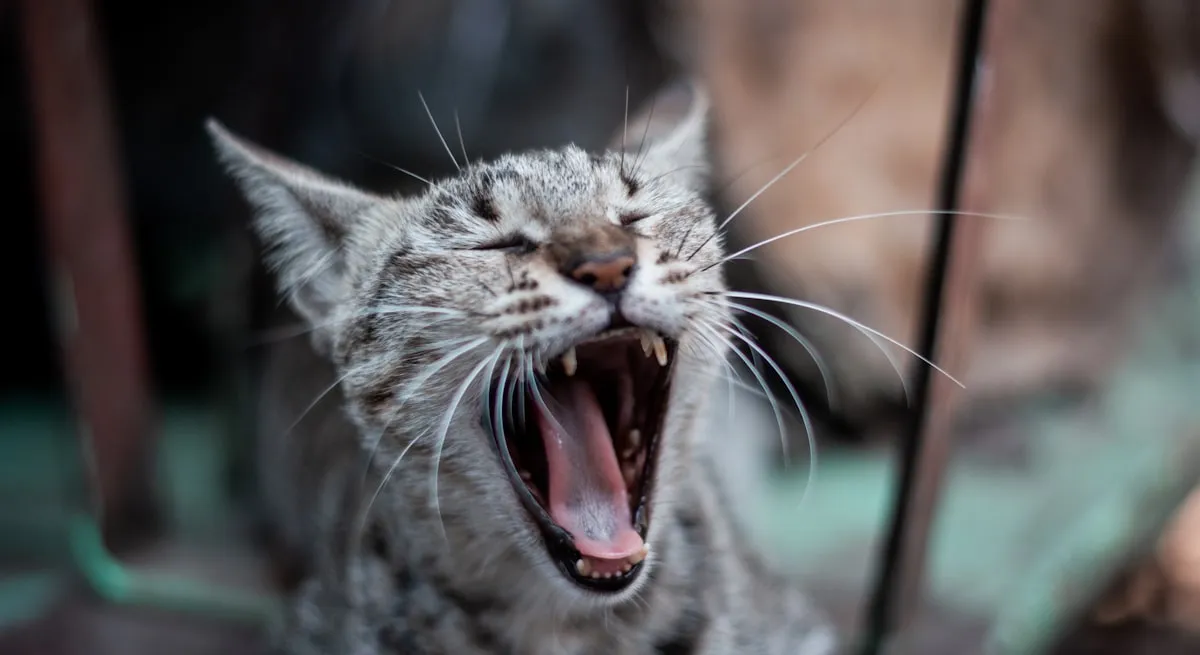
Hissing is one of the most misunderstood vocalizations in the feline repertoire. Most owners interpret it as aggression — "my cat is being mean." But the research tells a very different story: hissing is almost always a defensive signal, not an offensive one. Your cat isn't attacking. They're warning.
Yeon (2020), in a comprehensive review published in the Journal of Veterinary Science, classified cat vocalizations into three acoustic categories. Hissing falls into the "broadband" category — a rapid burst of air through a constricted mouth that produces an unmistakable sharp sound. It's the feline equivalent of saying "back off, please."
Understanding why your cat is hissing — not just that they are — is the key to responding correctly.
What Hissing Actually Is (And Isn't)
Hissing is not a sign of an aggressive cat. It's the opposite.
An offensively aggressive cat — one that's actively looking for a fight — doesn't hiss. They stalk, they stare, they attack. Hissing is what cats do when they want to avoid a confrontation. It's a distance-increasing signal: "I feel threatened, and I'm asking you to back away before this escalates."
Think of it as the feline version of a rattlesnake's rattle — in fact, some researchers have proposed that the hiss may have evolved as acoustic mimicry of snake sounds, though this remains debated in the ethological literature.
What's not debated: hissing is a communication tool, and a remarkably effective one. When a cat hisses, most threats — other cats, dogs, humans — instinctively pause or retreat. That's the entire point.
Kittens can produce hissing sounds as early as 2-3 weeks of age, even before their eyes are fully open (Yeon, 2020). This suggests the behavior has a strong innate component — it doesn't need to be learned.
The 6 Real Reasons Cats Hiss
1. Fear
The most common cause. By far.
Amat and Manteca (2019), writing in the Journal of Feline Medicine and Surgery, identified fear as the primary emotional driver behind the majority of cat aggression — including hissing. Cats who hiss at strangers, at the vet, at unfamiliar objects, or during thunderstorms are almost always experiencing genuine fear.
What it looks like: Hissing combined with flattened ears, dilated pupils, crouched posture, and a desire to flee. The cat is saying "I'm scared and I need you to stop."
What to do:
- Don't approach or try to comfort them physically — this increases their arousal
- Remove the stressor if possible
- Give them an escape route to a safe space (under a bed, in a closet, on a high shelf)
- Once the situation has resolved, let them approach you on their own terms
2. Pain
This is the one that catches most owners off guard — and the one with the most serious implications.
A cat who suddenly starts hissing when touched in a specific area, when picked up, or when moving in a particular way may be experiencing pain. Cats are notorious for masking pain, and hissing when touched can be one of the first detectable signals.
Common pain-related hissing triggers:
- Being touched on the abdomen (possible urinary or GI issue)
- Being picked up (possible spinal, hip, or joint pain)
- Having paws handled (possible nail or pad injury)
- Being touched near the mouth (possible dental abscess)
What to do: If hissing at touch is new and you can't identify an obvious environmental trigger, schedule a vet visit. This is especially urgent if accompanied by other behavioral changes — reduced appetite, hiding, changes in litter box habits, or lethargy.
3. Territorial Defense
When a new cat, a stray visible through the window, or even a new pet of any species enters the picture, resident cats may hiss as a territorial warning.
The 2024 AAFP Intercat Tension Guidelines (Rodan et al., 2024) note that intercat tension affects between 62.2% and 87.7% of multi-cat households. Hissing is often the first vocal signal in escalating territorial conflict.
What it looks like: Hissing directed at another cat (or sometimes at a window where an outdoor cat is visible), often with stiff posture and a direct stare.
What to do:
- Don't punish the hissing — it's a natural de-escalation tool
- Separate the cats if the situation seems to be escalating toward physical contact
- If introducing a new cat, slow down the introduction process dramatically
- Ensure each cat has their own resources (food, water, litter box, resting spot)
4. Redirected Frustration
This is the scenario that baffles owners most: your cat is staring out the window at a bird or a stray cat, then suddenly whips around and hisses at you or another household pet.
Amat et al. (2008), published in JAVMA, studied redirected aggression specifically. They found that 95% of redirected aggression events were triggered by either loud sounds or visual contact with other cats. The cat becomes highly aroused by a stimulus they can't reach, and the arousal "redirects" to the nearest available target.
What to do:
- Don't take it personally — the hiss isn't about you
- Don't approach or try to pet a highly aroused cat
- Block visual access to the trigger if possible (close blinds)
- Give the cat 15-30 minutes to calm down before interacting
5. Overstimulation During Petting
You're petting your cat, they're purring, everything seems perfect — then suddenly they hiss and swat at your hand. This is petting-induced aggression, and it's extremely common.
Amat and Manteca (2019) describe this as potentially resulting from a "motivational conflict" — the cat simultaneously wants contact and has a low tolerance threshold for sustained stimulation. Every cat has a different threshold, and the hiss is the "I've had enough" signal that often follows more subtle cues you may have missed (tail swishing, ear rotation, skin twitching).
What to do:
- Stop petting immediately — they've communicated clearly
- Don't pull your hand away dramatically (this can trigger a predatory response)
- Learn your cat's specific threshold. Most cats have preferred petting zones (head, chin, cheeks) and trigger zones (belly, base of tail, paws)
- Watch for the subtle pre-hiss signals: tail starts moving, ears rotate sideways, body stiffens
6. Protecting Resources or Offspring
Mother cats with kittens will hiss at anything that approaches their nest — including trusted humans. This is a deeply hardwired protective behavior.
Resource guarding, while less common in cats than dogs, can also cause hissing — particularly in multi-cat households where one cat controls access to food bowls, favored sleeping spots, or litter boxes.
What to do:
- Respect the mother cat's space — she's doing her job
- For resource guarding, add more resources in separate locations to reduce competition
What NOT to Do When Your Cat Hisses
Don't punish. Spraying water, yelling, or physically disciplining a hissing cat doesn't reduce the behavior — it increases the fear that caused it, creating a negative feedback loop.
Don't force interaction. The worst response to a hissing cat is to pick them up "to show them it's okay." A cat who is hissing is communicating that they need space. Violating that boundary damages trust.
Don't stare back. Direct eye contact during a fear response escalates the situation. Look away, blink slowly, or turn your body to the side to appear less threatening.
Don't ignore it. While a single hiss at a specific trigger is normal communication, chronic or increasing hissing warrants investigation — either something in their environment is stressing them, or they may be in pain.
When Hissing Becomes a Pattern: The Monitoring Challenge
Occasional hissing in response to specific triggers is normal, healthy communication. But when hissing frequency increases over time — or when a previously non-reactive cat begins hissing regularly — it's a signal that something systemic is changing.
The challenge is that these patterns often emerge gradually. A cat who hisses once when you touch their hip might be mildly uncomfortable. A cat who hisses every time you touch their hip, increasing over 2-3 weeks, may have a developing orthopedic issue.
Detecting frequency changes requires consistent observation over time — exactly the kind of monitoring that's difficult to maintain through casual human observation alone. This is particularly true when hissing behavior occurs during hours when you're not home or are asleep.
AI-powered behavioral monitoring systems can track vocalization patterns, activity levels, and interaction changes over weeks and months, surfacing trends that would be invisible to even the most attentive owner. If your cat's stress vocalizations are increasing 15% week over week, that's information worth having — before the underlying cause becomes a crisis.
Catellect's monitoring system is designed to capture exactly these kinds of longitudinal behavioral patterns, giving you data where before you had only intuition.
The Bottom Line
Your cat isn't being mean. They're talking. And they're saying one very specific thing: "I need space right now."
The appropriate human response is almost always the same: respect the request, identify the trigger, and address the root cause — whether that's fear, pain, overstimulation, or territorial stress.
A cat who hisses and is respected for it will actually trust you more over time. A cat who hisses and is punished or forced into contact will trust you less — and eventually, the hiss may escalate to a bite or scratch.
Listen to the hiss. It's a gift of communication.
Know When Something's Wrong
Catellect is building smart monitoring tools that track your cat's behavioral patterns over time — helping you catch changes in stress signals, activity, and interaction before they become emergencies.
Join our waitlist for early access and updates.
👉 Join the Catellect Waitlist at catellect.com
References cited in this article:
- Yeon, S.C. (2020). Feline vocal communication. Journal of Veterinary Science, 21, e18.
- Amat, M. & Manteca, X. (2019). Common feline problem behaviours: Owner-directed aggression. Journal of Feline Medicine and Surgery, 21(3), 245–255.
- Amat, M. et al. (2008). Evaluation of inciting causes, alternative targets, and risk factors associated with redirected aggression in cats. JAVMA, 233(4), 586–591.
- Rodan, I. et al. (2024). 2024 AAFP intercat tension guidelines. Journal of Feline Medicine and Surgery.
Related reading: