Cats Fighting at Home? A Science-Based Guide to Multi-Cat Conflict
"My two cats were best friends for 3 years. Then one day, out of nowhere, they just started fighting. Real fighting — screaming, fur flying, blood drawn. We've separated them but I don't know how to fix this. It's like they forgot they ever liked each other." — r/CatAdvice user
If this sounds familiar, you're not alone. And here's the hard truth: multi-cat conflict is one of the most common and most stressful problems cat owners face, and it's far more prevalent than most people realize.
The 2024 AAFP Intercat Tension Guidelines — the most comprehensive clinical resource on this topic, authored by a task force of board-certified veterinary behaviorists — report that intercat tension affects between 62.2% and 87.7% of multi-cat households globally. That's not a small minority. That's the majority.
Elzerman et al. (2020), in a survey of 2,492 U.S. multi-cat households published in the Journal of Feline Medicine and Surgery, found that 73.3% of owners observed conflict signs from the very first day when introducing cats. Staring was the most frequently observed conflict signal, occurring daily in 44.9% of households.
The good news: the research is clear on what works and what doesn't. Let's get into it.
Play Fighting vs. Real Fighting: How to Tell the Difference
This is the first question most owners ask, and it's critical to answer correctly.
Signs of Play
- Roles alternate. Both cats take turns being the chaser and the chased, the pouncer and the "prey."
- No hissing or screaming. Play is relatively quiet. Occasional chirps or soft meows, but no growling, hissing, or yowling.
- Relaxed body language between bouts. After a tumble, both cats separate, groom, or simply sit near each other without tension.
- Ears forward. During play, ears stay in a neutral or forward position.
- Inhibited bites. Play bites don't draw blood. Claws are usually retracted.
Signs of Real Aggression
- One cat is always the aggressor. There's no role-switching. One cat pursues and the other consistently retreats.
- Hissing, growling, screaming. Vocal intensity escalates.
- Puffed fur, arched backs. Piloerection and defensive postures signal genuine fear or aggression.
- Ears flattened. Both cats display flat or rotated ears.
- Injuries. Scratches, bite wounds, or clumps of fur on the floor.
- Avoidance after the encounter. One or both cats hide, refuse to eat, or avoid shared spaces for hours or days.
Crowell-Davis, Curtis, and Knowles (2004), in their review of feline social organization published in the Journal of Feline Medicine and Surgery, noted that cats don't operate on a linear dominance hierarchy like dogs. Instead, their social relationships are more fluid and context-dependent — which means that what looks like sudden aggression may actually be a relationship renegotiation triggered by a change you didn't notice.
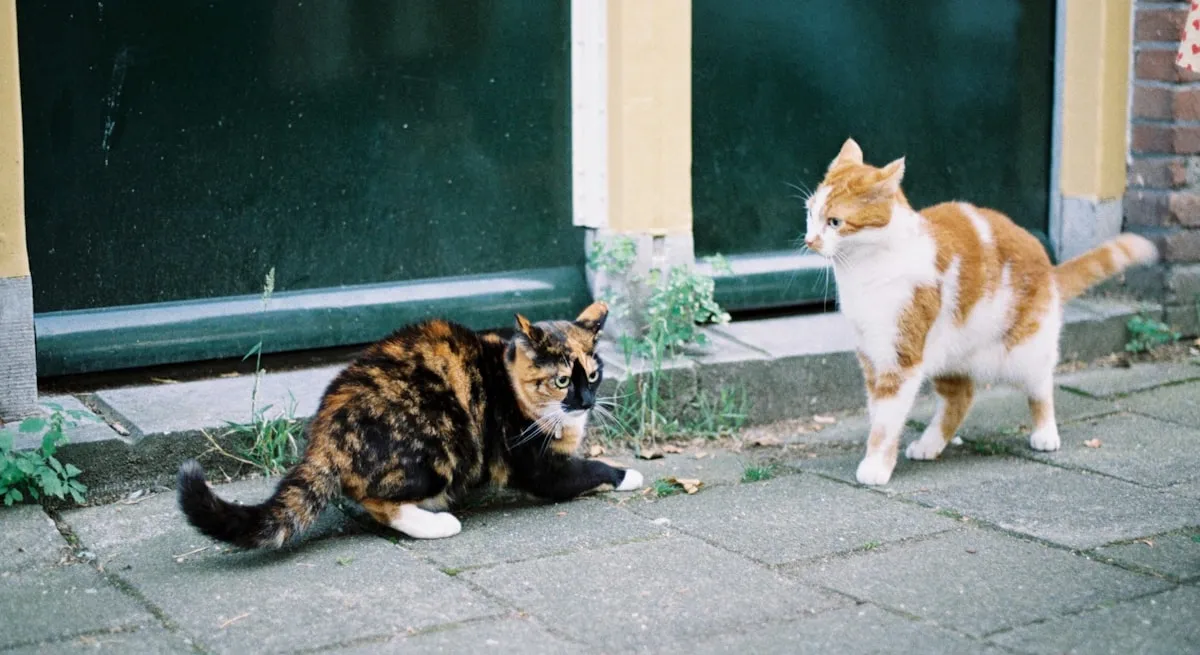
Why Cats Who "Got Along" Suddenly Start Fighting
This is the scenario that confuses owners most — and it has predictable triggers.
Trigger 1: Non-Recognition Aggression
One of the most common causes of sudden conflict between previously bonded cats. It happens when one cat returns from the vet (or groomer, or boarding) smelling different. The returning cat doesn't smell like "family" anymore — they smell like antiseptic, other animals, or unfamiliar chemicals.
The resident cat reacts to this unfamiliar scent the way they would to a stranger: with hostility. And once a fight occurs, the relationship damage can persist long after the scent normalizes.
Prevention: When bringing a cat home from the vet, isolate them in a separate room for a few hours. Let scents normalize before reintroduction. Some owners rub a towel on the resident cat and then on the returning cat to "blend" scents.
Trigger 2: Redirected Aggression
Amat et al. (2008) found that 95% of redirected aggression events in cats were triggered by loud sounds or the sight of other cats. Here's how it plays out between household cats:
Cat A sees a stray cat through the window. Cat A becomes highly aroused. Cat B walks past. Cat A, unable to reach the stray, attacks Cat B. Cat B now associates Cat A with a terrifying unprovoked attack. Trust is broken.
Prevention: Block visual access to outdoor cats if they trigger your indoor cats. Close blinds during peak stray activity times (dawn and dusk).
Trigger 3: Pain or Illness
A cat experiencing pain may become irritable and lash out at companions. Cats with undiagnosed dental disease, arthritis, urinary issues, or GI discomfort may show increased aggression toward housemates because being touched or even approached hurts.
The AAFP guidelines emphasize that any sudden onset of intercat aggression should prompt a veterinary examination for both cats — the aggressor and the victim. Pain in either cat can destabilize the relationship.
Trigger 4: Resource Competition
This is the slow-burn trigger. It doesn't cause a sudden explosion — it causes a gradual erosion of tolerance.
Ramos (2019), in her comprehensive review of multi-cat household aggression in JFMS, detailed how resource competition drives conflict: one cat begins controlling access to the litter box, the food bowl, the favorite sleeping spot, or even the human's lap. The other cat tolerates it... until they don't.
The insidious part: owners often don't recognize resource guarding because cats do it subtly. A cat sitting in a doorway isn't "relaxing" — they may be blocking another cat's access to the litter box down the hall.
Trigger 5: Social Maturity
Cats reach social maturity between 2-4 years of age. Cats who were playful friends as juveniles may develop new social boundaries as they mature, leading to increased tension. This is a normal developmental process, not a behavior problem — but it requires environmental adjustments.
The Evidence-Based Resolution Protocol
Step 1: Separate Completely
If fighting has occurred, full separation is the necessary first step. This means:
- Separate rooms with closed doors
- Each cat gets their own food, water, litter box, and resting spots
- No visual contact through baby gates or glass doors initially
- Minimum 48-72 hours of separation before beginning reintroduction
This is not punishment. It's a neurological reset. A cat in a state of arousal needs time — often days — for stress hormones to return to baseline.
Step 2: Rule Out Medical Issues
Before beginning behavioral work, have both cats examined by a veterinarian. The AAFP guidelines specifically recommend this step, noting that undiagnosed pain is a frequently overlooked contributor to intercat aggression.
Step 3: Scent Exchange (Days 3-7)
Before any visual contact, exchange scents:
- Swap bedding between rooms
- Rub a sock or cloth on one cat's cheeks (where pheromone glands are located) and place it in the other cat's space
- Feed both cats near the closed door (but not directly at it — start a few feet away)
The goal: rebuild scent familiarity without the stress of visual or physical contact.
Step 4: Visual Contact Without Physical Access (Days 7-14+)
Use a baby gate or a cracked door to allow visual contact. Feed high-value treats during these sessions. Keep sessions short (5-10 minutes) and end on a positive note.
Watch for these positive signals:
- Eating near each other
- Relaxed body posture
- Slow blinks directed at each other
- Curiosity without aggression
Watch for these warning signals:
- Staring without blinking
- Tail swishing
- Growling or hissing
- Puffed fur
If warning signals appear, end the session calmly and extend the timeline. Rushing this process is the most common mistake.
Step 5: Supervised Coexistence (Days 14+)
Gradually increase shared space and time. Always supervise. Always have an interruption plan (a pillow to toss between them, a blanket to separate them — never your hands).
Elzerman et al. (2020) found that despite 73% of owners observing initial conflict, affiliative behaviors (physical contact, mutual grooming, sleeping together) were actually observed more frequently than conflict behaviors in established multi-cat households. Relationships can recover — but they need time and structure.
Environmental Setup That Prevents Conflict
The research consistently points to environmental design as the single most important preventive measure.
The Resource Formula
The classic guideline: one resource per cat, plus one extra. This applies to:
- Litter boxes
- Feeding stations
- Water sources
- Resting/sleeping spots
- Vertical spaces (cat trees, shelves, perches)
But location matters as much as quantity. Three litter boxes in the same room = one litter box, functionally. Resources need to be distributed across the home so that no single cat can control access to all of them.
Vertical Territory
Cats who share horizontal space often conflict. Cats who have vertical options — cat trees, wall shelves, window perches at different heights — can share a room by occupying different planes.
The AAFP guidelines emphasize that vertical space is one of the most effective conflict-reduction tools in multi-cat households. A cat who can observe from a high perch feels safer than a cat on the floor.
Escape Routes
Dead-end rooms, narrow hallways with only one exit, and covered litter boxes (which trap a cat inside) create ambush opportunities. Ensure every key space has multiple entry/exit points.
Pheromone Support
DePorter et al. (2019), in a randomized double-blind placebo-controlled trial published in JFMS, found that Feliway Friends (a synthetic cat appeasing pheromone) significantly reduced aggressive behaviors in multi-cat households compared to placebo. Effects persisted even after the product was removed.
While pheromone therapy isn't a standalone solution, it's a useful adjunct to behavioral and environmental interventions.
The Hidden Conflict: What You Can't See
Here's the critical insight most owners miss: the most damaging form of intercat conflict isn't the dramatic fight. It's the silent bullying — the staring, the blocking, the subtle resource control that happens when you're not watching.
A cat who is being passively bullied by a housemate may never hiss, never fight, never show any obvious sign of conflict. Instead, they slowly become:
- More withdrawn
- Less active
- Less playful
- Reluctant to use the litter box
- Prone to stress-related illness (urinary problems, GI issues, over-grooming)
These patterns develop gradually over weeks and months, during the hours when you're at work or asleep. By the time you notice something is wrong, the stress has been chronic for a long time.
This is where continuous behavioral monitoring becomes genuinely valuable. AI-powered systems that track each cat's activity patterns, resting locations, movement through the home, and daily behavioral rhythms can detect the subtle shifts that indicate mounting tension — the cat who stopped visiting the living room, the cat whose nighttime activity has tripled, the cat whose visits to the litter box have decreased.
Catellect's multi-device monitoring system is designed for exactly this: understanding the dynamics of a multi-cat household at a level of detail that human observation simply can't achieve.
When to Seek Professional Help
Consider consulting a veterinary behaviorist (a board-certified DACVB specialist) if:
- Fights have resulted in injuries
- Separation has lasted more than 2 weeks without improvement
- One or both cats show signs of chronic stress (over-grooming, inappropriate elimination, appetite changes)
- Behavioral modification hasn't produced results after 4-6 weeks
- You're considering surrendering one of the cats
The AAFP guidelines note that in some cases, medication may be appropriate as part of a comprehensive behavioral plan. Commonly used medications include:
- Fluoxetine — for chronic anxiety and aggression
- Gabapentin — for acute situational anxiety
- Buspirone — sometimes used specifically for inter-cat aggression
These should only be used under veterinary supervision and in combination with environmental and behavioral modifications — never as standalone treatments.
Peaceful Coexistence Is Possible
The research is encouraging: most multi-cat conflicts are resolvable with proper environmental management, patient reintroduction, and attention to each cat's individual needs. Some cats will become best friends again. Others will settle into a respectful coexistence — not cuddling, but sharing space without stress.
Both outcomes are wins.
Understand Your Multi-Cat Household
Catellect is building monitoring tools designed for multi-cat homes — tracking individual behavioral patterns, flagging tension signals, and helping you maintain peace before problems escalate.
Join our waitlist for early access and updates.
👉 Join the Catellect Waitlist at catellect.com
References cited in this article:
- Rodan, I. et al. (2024). 2024 AAFP intercat tension guidelines. Journal of Feline Medicine and Surgery.
- Elzerman, A.L. et al. (2020). Conflict and affiliative behavior frequency between cats in multi-cat households. JFMS, 22(8), 705–717.
- Ramos, D. (2019). Common feline problem behaviors: Aggression in multi-cat households. JFMS, 21(3), 221–233.
- Amat, M. et al. (2008). Evaluation of inciting causes associated with redirected aggression in cats. JAVMA, 233(4), 586–591.
- Crowell-Davis, S.L. et al. (2004). Social organization in the cat. JFMS, 6(1), 19–28.
- Levine, E. et al. (2005). Intercat aggression in households following the introduction of a new cat. Applied Animal Behaviour Science, 90(3-4), 325–336.
- DePorter, T.L. et al. (2019). Evaluation of the efficacy of an appeasing pheromone diffuser product vs placebo. JFMS, 21(4), 293–305.
Related reading: