Why Does My Cat Bite Me? 7 Types of Cat Bites Explained
"She was purring, kneading, eyes half-closed... then just BIT me on the hand. Hard. And went right back to purring. What is wrong with my cat?" — r/cats user
Nothing is wrong with your cat. But something is wrong with how most of us interpret cat bites.
Here's the reality: "my cat bit me" covers at least seven fundamentally different behaviors, each with different causes, different meanings, and different appropriate responses. Treating all bites the same — as "aggression" — leads to misunderstanding your cat and often makes the problem worse.
Amat and Manteca (2019), in their review of owner-directed aggression published in the Journal of Feline Medicine and Surgery, identified four primary categories of biting behavior toward humans: play aggression, fear-based aggression, petting-induced aggression, and redirected aggression. Each requires a completely different response.
Let's decode all seven.
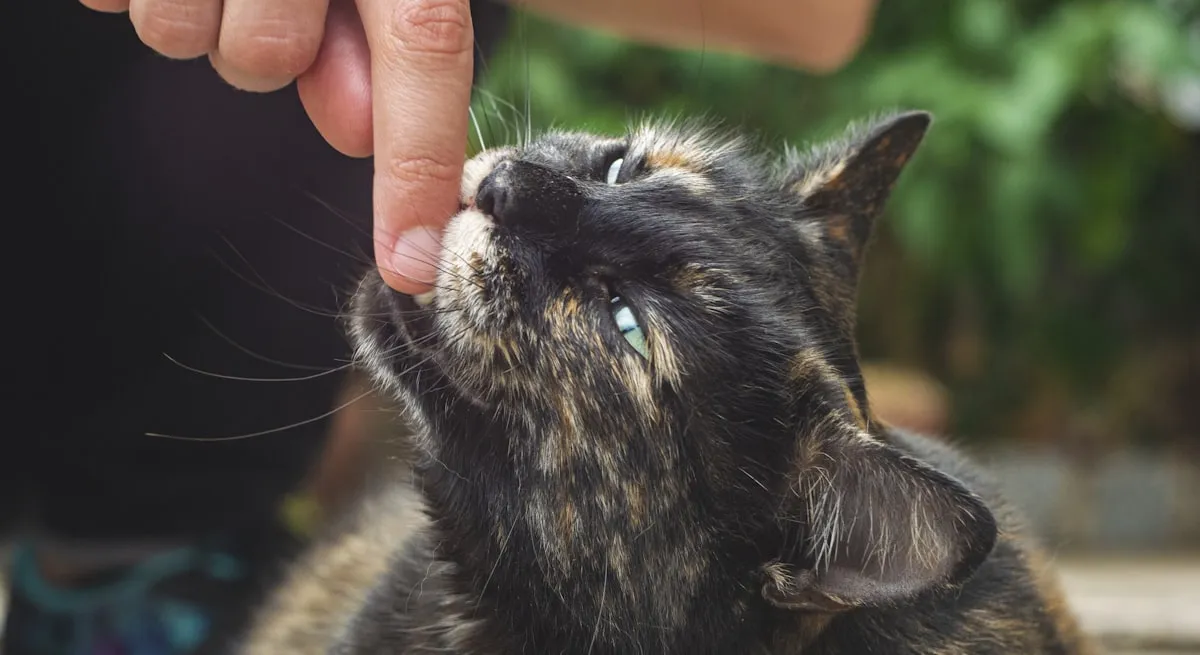
Type 1: The Love Bite (Gentle Nibble)
What it feels like: A soft, controlled bite — more of a press or nibble than a puncture. Often directed at fingers, chin, nose, or earlobes. Frequently accompanied by purring.
What it means: Affection. Your cat is engaging in a form of social grooming behavior. Van den Bos (1998), studying allogrooming in domestic cats, found that mutual grooming among cats frequently includes gentle biting — particularly around the head and neck. When your cat softly nibbles you, they're treating you as a bonded social partner.
What to do: Nothing, unless it bothers you. If you want to discourage it, simply redirect attention to a toy or gently disengage. No punishment needed.
When to worry: Love bites that gradually become harder over time may indicate your cat is struggling to calibrate bite pressure — often a sign of early weaning or inadequate socialization with littermates.
Type 2: Petting-Induced Bite (Overstimulation)
What it feels like: A sudden, firm bite during what seemed like a perfectly pleasant petting session. Often directed at the petting hand. May include a swat with claws extended.
What it means: Your cat reached their stimulation threshold. This is the most researched biting behavior and one of the most common reasons owners seek behavioral help.
Fritz et al. (2022), in a groundbreaking study published in the Journal of Applied Behavior Analysis, conducted the first functional analysis of petting-induced aggression in cats. Their finding was striking: in all three cats studied, the biting behavior was maintained by social negative reinforcement — the bite successfully stopped the unwanted stimulation. In other words, your cat isn't being malicious. They've learned that biting is the fastest way to make the petting stop.
Amat and Manteca (2019) note that the precise mechanism remains debated — it may be a motivational conflict (wanting contact but having low tolerance) or simple overstimulation — but the behavioral pattern is consistent: the cat enjoys petting for a period, becomes increasingly uncomfortable, sends warning signals, and then bites when the warnings are ignored.
The warning signals you're missing:
- Tail starts twitching or swishing
- Skin ripples along the back (cutaneous reflex)
- Ears rotate from forward to sideways
- Body stiffens
- The cat turns to look at your hand
- Purring stops (or changes quality)
What to do:
- Learn your cat's specific threshold. Some cats tolerate 2 minutes of petting. Others tolerate 30 seconds.
- Stop petting before the threshold. Leave them wanting more.
- Pet in preferred zones: cheeks, chin, behind ears. Avoid belly, base of tail, and lower back — the areas most commonly associated with overstimulation.
- When you see the first warning signal (typically tail movement), stop immediately.
Haywood et al. (2021), published in Frontiers in Veterinary Science, found that people who followed specific handling guidelines — including letting the cat initiate contact and restricting petting to the head/chin area — experienced significantly less aggression and more affiliative behavior from cats.
Type 3: Play Bite (Predatory Play)
What it feels like: Quick, often surprising bites directed at moving targets — your ankles as you walk, your fingers wiggling under a blanket, your toes in bed at 3am. May include the full predatory sequence: stalk, pounce, grab, bite.
What it means: Your cat is playing. Specifically, they're practicing predatory behavior — and your moving body parts are the most interesting "prey" available.
Curtis (2008) notes that play aggression is the most common form of aggression in kittens and young cats, particularly those who were raised without littermates. Cats learn bite inhibition through play with siblings — when a kitten bites too hard, the sibling yelps and stops playing. Cats raised alone miss this lesson.
What to do:
- Never use your hands as toys. This is the single most important prevention rule. If your hands are toys, bites are inevitable.
- Redirect to appropriate toys — wand toys, kicker toys, balls
- Provide at least two active play sessions daily (10-15 minutes each) to satisfy the hunting drive
- If your cat ambushes your ankles, it's almost always a sign of insufficient play stimulation
What NOT to do: Don't yell, spray water, or physically punish. This doesn't teach bite inhibition — it teaches fear, which leads to fear-based aggression (a much worse problem).
Type 4: Fear Bite (Defensive)
What it feels like: A hard, rapid bite — often multiple bites in succession — accompanied by hissing, flat ears, and an attempt to flee immediately after.
What it means: Your cat is terrified and feels trapped. This isn't aggression in the offensive sense — it's pure self-defense.
Reisner et al. (1994), published in Physiology & Behavior, found that early handling experiences and paternal genetics both significantly influence a cat's defensive aggression threshold. Some cats are genetically predisposed to lower fear thresholds, meaning they're more likely to bite defensively.
Common triggers:
- Being cornered or physically restrained
- Loud, sudden noises (fireworks, dropping pots)
- Unfamiliar people approaching too quickly
- Forced nail trimming, bathing, or medication
- Returning from the vet smelling different
What to do:
- Give the cat an escape route — always
- Approach fearful cats sideways, not head-on
- Use slow blinks and avoid direct eye contact
- For necessary handling (vet visits, medication), ask your vet about gabapentin pre-medication for anxiety
- Long-term: work on gradual desensitization using positive reinforcement
Type 5: Redirected Bite
What it feels like: An apparently random, unprovoked attack. Hard bite, often breaking skin.
What it means: Your cat was aroused by something else entirely — a stray cat outside, a loud noise, another pet — and you happened to be the nearest target when their arousal peaked.
Amat et al. (2008) found that redirected aggression accounts for approximately 50% of human-directed aggression cases in cats. The cat isn't angry at you. They've reached a level of arousal where they respond aggressively to any nearby stimulus.
What to do:
- Do NOT approach a highly aroused cat
- If you see signs of arousal (puffed fur, fixed stare, thrashing tail, dilated pupils), leave the room
- Wait 15-30 minutes for the cat to calm down
- Identify and manage the original trigger (block window access to stray cats, reduce noise exposure)
Type 6: Pain-Related Bite
What it feels like: A sharp, sudden bite when you touch a specific area of the cat's body. The cat may also hiss or flinch.
What it means: You touched something that hurts. The bite is a reflexive "stop that."
Common pain sources:
- Dental disease (bites when touching face)
- Arthritis (bites when manipulating joints)
- Urinary tract issues (bites when touching abdomen)
- Skin conditions (bites when touching affected area)
- Old injuries or surgical sites
What to do: Schedule a vet exam. A cat who bites when a specific body area is touched is giving you diagnostic information. Use it.
Type 7: Demand Bite (Attention-Seeking)
What it feels like: A light-to-moderate bite, often on the hand, arm, or face, when you're ignoring your cat. Not accompanied by any fear signals.
What it means: Your cat wants something — food, attention, a door opened — and has learned that biting gets a faster response than meowing.
Vitale Shreve, Mehrkam, and Udell (2017), in their study published in Behavioural Processes, found that 50% of cats preferred social interaction with their owner over food, toys, or scent stimuli. Cats are more socially motivated than most people realize, and some develop escalating attention-seeking strategies.
What to do:
- Don't reward the bite with the desired response (feeding, petting, or even scolding — all are attention)
- Wait for a non-biting behavior (sitting calmly, meowing) and then provide what they want
- Increase scheduled interaction time so the cat's social needs are met proactively
The Bigger Picture: Biting as Communication
Every type of bite, at its core, is communication. Your cat is telling you something specific — "I'm overstimulated," "I'm scared," "I want to play," "that hurts," "pay attention to me."
The question isn't "how do I stop my cat from biting?" It's "what is my cat trying to tell me?"
De Mouzon and Leboucher (2023), published in Animals, found that cats respond to multimodal communication — combining visual, auditory, and tactile signals — faster than single-channel communication. This means your body language, voice tone, and handling approach all affect how your cat communicates back. Tense handling begets tense responses.
The Pattern Problem
Individual biting incidents are usually manageable. The real concern is when biting frequency increases over time — suggesting an escalating underlying issue (growing pain, mounting stress, insufficient stimulation, or environmental change).
Tracking these patterns over weeks and months — when bites happen, what preceded them, where on the body — reveals root causes that individual incidents obscure. This is the kind of longitudinal behavioral data that's difficult to maintain manually but incredibly valuable for understanding your cat.
Catellect's behavioral monitoring system tracks activity patterns, interaction changes, and daily behavioral rhythms that can contextualize biting patterns — helping you and your vet understand the "why" behind the behavior.
Build a Better Relationship With Your Cat
Understanding biting behavior is the first step toward a deeper, more trusting relationship. Your cat isn't broken. They're communicating in the only language they have.
Join our waitlist for smart monitoring tools that help you understand your cat on a deeper level.
👉 Join the Catellect Waitlist at catellect.com
References cited in this article:
- Amat, M. & Manteca, X. (2019). Common feline problem behaviours: Owner-directed aggression. JFMS, 21(3), 245–255.
- Fritz, J.N. et al. (2022). Functional analysis and treatment of aggression exhibited by cats toward humans during petting. Journal of Applied Behavior Analysis, 55(1), 169–179.
- Curtis, T.M. (2008). Human-directed aggression in the cat. Veterinary Clinics of North America: Small Animal Practice, 38(5), 1131–1143.
- Reisner, I.R. et al. (1994). Friendliness to humans and defensive aggression in cats. Physiology & Behavior, 55(6), 1119–1124.
- Amat, M. et al. (2008). Evaluation of inciting causes associated with redirected aggression in cats. JAVMA, 233(4), 586–591.
- Haywood, C. et al. (2021). Providing humans with practical handling guidelines increases cats' affiliative behaviour. Frontiers in Veterinary Science, 8, 714143.
- Van den Bos, R. (1998). The function of allogrooming in domestic cats. Journal of Ethology, 16(1), 1–13.
- Vitale Shreve, K.R. et al. (2017). Social interaction, food, scent or toys? Behavioural Processes, 141, 322–328.
- de Mouzon, C. & Leboucher, G. (2023). Multimodal communication in the human-cat relationship. Animals, 13(9), 1528.
Related reading: