Is a Cat Translator Real?
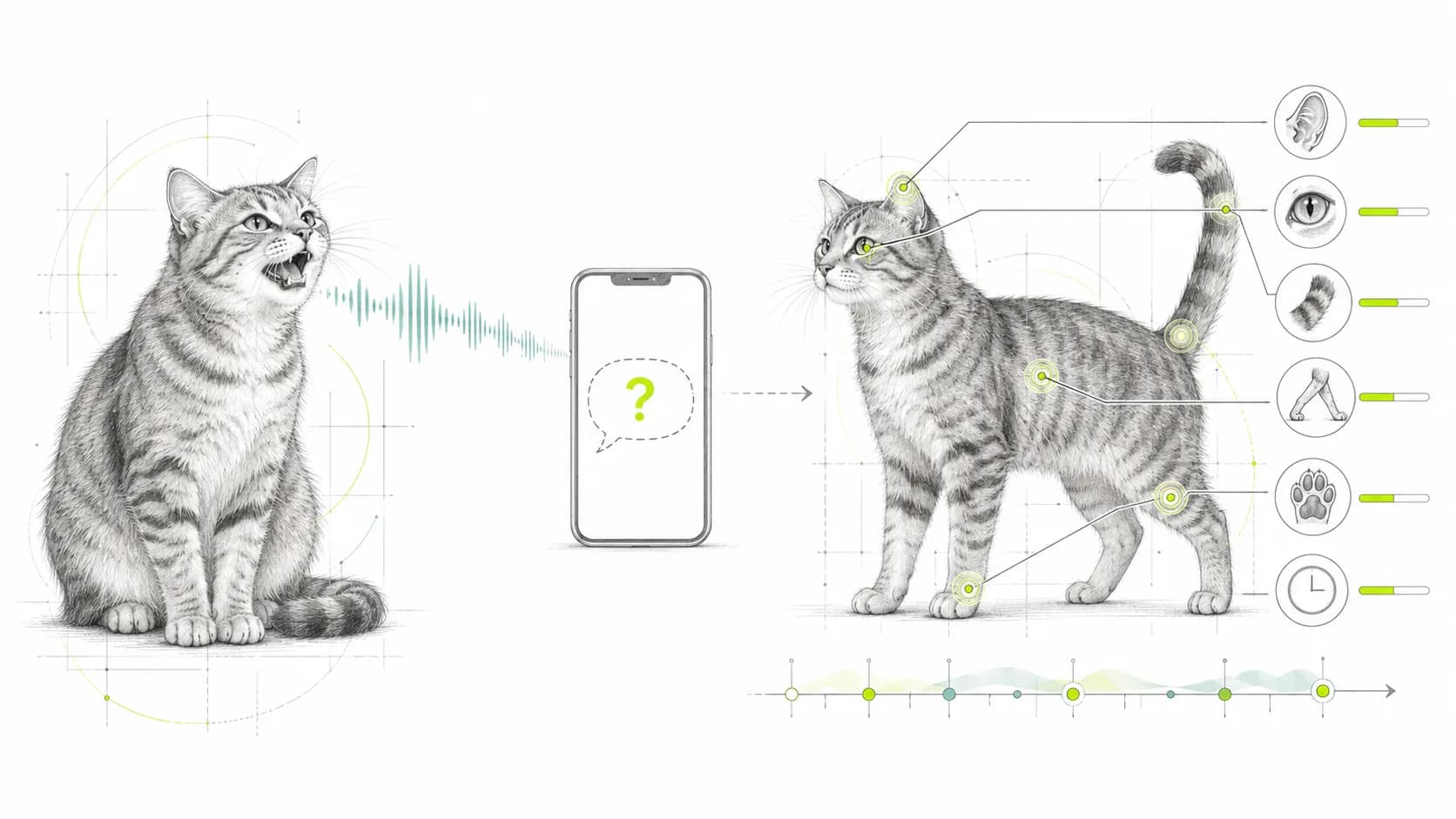
People type "is cat translator real" because the category now has a simple pitch: hold the phone up, catch a meow, read a sentence. "I'm hungry." "I'm lonely." "I love you." Sometimes with a round accuracy number attached.
A meow is a human-directed attention call. The published listening studies treat it as a coarse signal. Listeners hearing an unfamiliar cat struggle to map a single meow onto even three ordinary household contexts.[1] Owners do somewhat better with their own cat, which is a different skill from translation.[12]
A meow carries less dictionary than the apps imply
In 2020, Prato-Previde and colleagues asked 225 adults to hear meows recorded while cats waited for food, were left alone, or were being brushed, then pick the context.[1] Chance was one in three. The best result, for food-related meows, was 40.44% correct. Isolation meows were assigned correctly 26.67% of the time. Even the most typical meow in each context was never recognized significantly above chance.[1]
Cat owners and people with higher cat-empathy scores did a little better on some clips. The overall picture stayed the same: humans have a limited capacity to extract precise information from cat vocalizations.[1]
Nicastro and Owren ran a similar test in 2003 with meows from 12 cats in five behavioral contexts.[2] Classification accuracy sat above chance, modestly. Bouts beat single calls. People who had lived with cats did better than people who had not. The authors found little evidence of referential meaning. They described meows as nonspecific, somewhat negatively toned stimuli that attract human attention.[2]
Experience helps a little, but it does not reveal a vocabulary.
Familiarity helps more. In a small exploratory study, Ellis and colleagues played owners meows from their own cat and from a cat they did not know. Some owners placed their own cat's meows in the right context above chance. No one managed it for the unfamiliar cat.[12] The authors concluded that domestic cats, as a species, do not share a context-specific repertoire of human-directed meows.[12] What an owner learns is one cat, not a language.
A 2025 acoustic study points the same way. Russo, Schild and Knörnschild describe meows as context-dependent signals directed mainly at humans. They found meows carry less individual identity than purrs, and domestic cat meows vary more than those of their wild relatives.[13] The authors read that as flexibility shaped by domestication.[13] A flexible signal is the opposite of a fixed dictionary.
A classifier score on three labels is a different job
Audio models can look strong when the question is small and fixed in advance. Researchers trained a classifier on meows recorded in the same three contexts (food, isolation, brushing), and it sorted those clips with high accuracy.[5]
That experiment answers one question: which of these three recorded situations produced this clip? An open-ended mood in a living room sits outside that setup.
The same three contexts where human listeners stayed near chance are the ones a constrained model can separate on a fixed dataset.[1][5] Consumer "translation" borrows the look of that score and asks a different question.
Cats already vote with their bodies
If voice were the main channel, talking should be the fastest way to get a cat to approach. de Mouzon and Leboucher tested vocal, visual, and bimodal (visual plus vocal) cues from an unfamiliar person with 12 café cats.[3] Cats approached faster to visual and bimodal communication than to voice alone.[3] They wagged their tails more when the person stayed silent than when the person used visual or bimodal cues, and more with voice alone than with bimodal cues. The authors read the extra tail wagging during silence as a sign the cats were less comfortable.[3]
Veterinary behavior work lands in the same place from the clinic. Mills and colleagues note that a cat's behavioral repertoire is finite, and the same visible behavior can appear under different emotional motivations.[4] Ears, tail, posture, location, who else is in the room, and whether this is normal for this cat do the work a meow cannot do by itself.[4][10][11]
What the translator products sell
MeowTalk calls itself a cat translator. It analyzes meows captured by a phone, assigns each meow one of a fixed set of "general states of mind," and "interprets them into human language."[8]
Traini's Play Store listing is framed as a dog translator. The app says it analyzes vocalizations, facial expressions, body language, and behavior patterns to infer a possible emotional state, including signals associated with joy and interest.[7] The product name still presents the output as translation.
PettiChat, from Hangzhou startup Meng Xiaoyi, has been presented as a real-time two-way pet translator. South China Morning Post reported that claim while testing the collar.[6]
The hardware mixes differ. The shared promise is a short clip in and a human sentence out. The listening studies say that sentence is doing more work than the sound can support.[1][2]
What is useful instead
A useful record keeps the observation and the story in separate columns.[10][11] It can say: the cat vocalized at the closed door, paced, and this is a change from this week's nights. "Lonely" stays an interpretation the owner can accept or reject.
Catellect's research direction is structured, inspectable feline behavior: posture, ears, tail, action, interactions, and scene, with wearable motion and home context around them.[9][10] Audio is one channel. The product question is whether a change is real for this cat, and which evidence supports it.
That is slower than a cartoon speech bubble. It is also closer to how cats actually communicate with people.[3][4]
Related reading: What Is Multimodal Feline Behavior Understanding? · Why General-Purpose AI Struggles to Understand Cats · Cat Body Language Decoded
FAQ
Is a cat translator real?
An app can classify a meow into a small set of labels. Published listening studies show people cannot reliably map a meow onto even three everyday contexts.[1] That is a weak basis for sentence-level translation.
Can AI translate cat meows into English?
AI can separate some acoustic patterns when the labels are few and known in advance.[5] English sentences imply word-like meaning. Nicastro and Owren found little evidence that meows work that way.[2]
Why do some apps quote high accuracy?
Ask what was classified. A high score on a few fixed lab contexts is a real result for that experiment.[5] A living-room mood dictionary is a different claim.
Do cats use meows as their main language with people?
The evidence points the other way. In a cat café study, cats approached an unfamiliar person faster when the person used visual or combined visual-vocal cues than when the person used voice alone.[3]
What should I watch if I want to understand my cat?
Body, place, and change over time: ears, tail, posture, where the cat is, who is nearby, and whether this is new for your cat.[4][10]
Sources
[1] What's in a Meow? A Study on Human Classification and Interpretation of Domestic Cat Vocalizations
[2] Classification of domestic cat vocalizations by naive and experienced human listeners
[3] Multimodal Communication in the Human–Cat Relationship: A Pilot Study
[4] Recognising and assessing feline emotions during the consultation
[5] Automatic Classification of Cat Vocalizations Emitted in Different Contexts
[6] Does China’s latest AI pet translator work?
[7] Traini - Dog Translator & Training (Google Play)
[8] MeowTalk Cat Translator (Google Play)
[9] Catellect-VL-2B: A Vision-Language Model for Edge-Based Feline Behavior Understanding
[10] What Is Multimodal Feline Behavior Understanding?