Why Does My Cat Lick Me? 5 Science-Backed Reasons
"My cat licks my arm for like 10 minutes straight every night before bed. It's kind of sweet but also her tongue is literally sandpaper and my skin is raw. Why is she doing this?" — r/cats user
Cat tongues are covered in tiny, backward-facing spines called papillae — made of keratin, the same material as claws. These spines serve as a remarkably efficient grooming tool, capable of detangling fur, removing parasites, and distributing skin oils. They also make being licked by your cat feel like being exfoliated with a cheese grater.
But your cat isn't licking you for exfoliation purposes. They're communicating something much more interesting.
The Biology of Cat Licking
To understand why your cat licks you, you first need to understand what licking means between cats.
Allogrooming: Not Just Cleaning
When one cat grooms another, it's called allogrooming — and it's one of the most studied social behaviors in feline ethology.
Van den Bos (1998), in a landmark study published in the Journal of Ethology, analyzed 83 grooming interactions in a group of 25 cats living in confinement. The findings were surprising:
- 91.6% of grooming was unidirectional — one cat groomed while the other received
- 78.6% of the time, the higher-ranking cat did the grooming
- Grooming was often directed at the head and neck — areas the recipient can't easily groom themselves
- Relatedness between cats did not affect grooming frequency
The conclusion: allogrooming in cats is not primarily about hygiene. It's a social management tool — a way of maintaining group cohesion and redirecting potential aggression into a positive interaction. Think of it as the feline equivalent of a tension-dissolving hug.
When your cat licks you, they're using the same behavioral program. You're part of their social group, and they're managing the relationship.
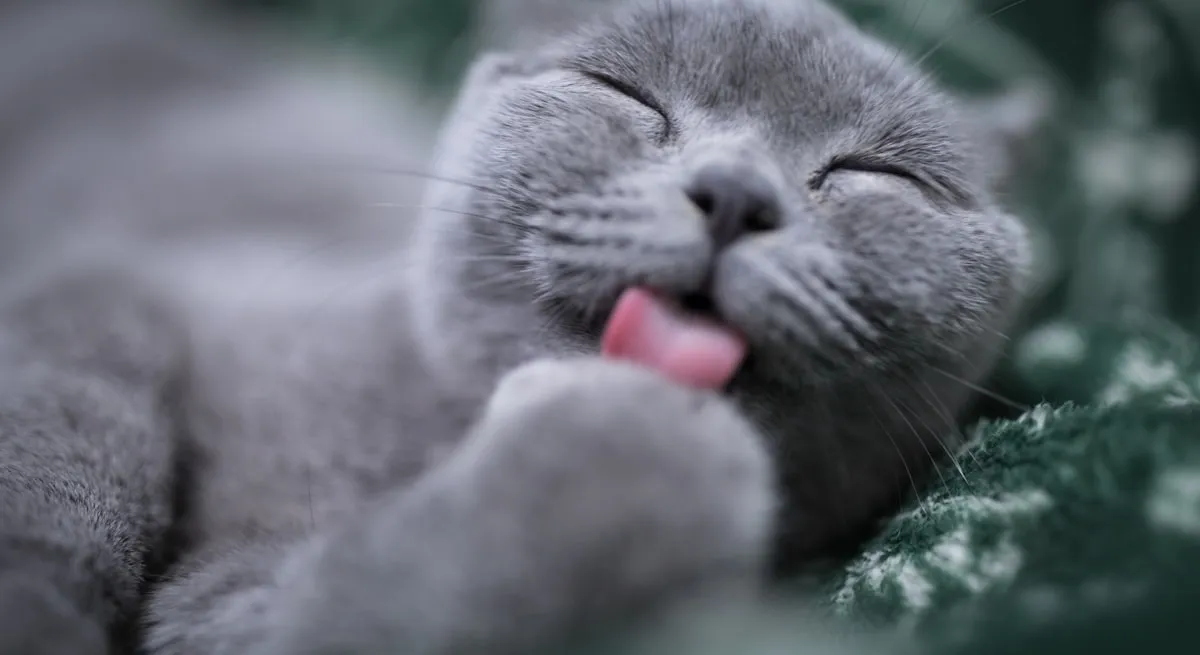
5 Reasons Your Cat Licks You
1. Social Bonding and Affiliation
This is the most common reason, and the most straightforward.
Vitale, Behnke, and Udell (2019), in their groundbreaking attachment study published in Current Biology, demonstrated that 65.8% of cats form a secure attachment bond with their primary human — statistically comparable to the rate observed in human infants (65%) and dogs (58%).
Cats who are securely attached to their owner engage in more affiliative behaviors — head bunting, slow blinking, body contact, and grooming/licking. Your cat licking you is one of the clearest behavioral indicators that they consider you a bonded social partner.
Bradshaw and Hall (1999), studying affiliative behavior in cat pairs, found that cats who grew up together showed significantly more mutual grooming and physical contact than unrelated pairs. Your cat treats you like family — and licking is family behavior.
Signs this is bonding licking:
- Occurs during calm, relaxed moments (evening cuddles, bedtime)
- Accompanied by purring, kneading, or slow blinking
- Directed at your hands, face, or hair
- Cat seems content and relaxed during the behavior
2. Scent Investigation and Mixing
Cats live in a world of scent. Your skin carries a complex chemical signature — from the lotions you use, the food you've touched, your natural skin oils, and even the trace scents of other animals or people you've been near.
When your cat licks your hand after you've been cooking, petting another animal, or applying lotion, they're conducting a chemical analysis of where you've been and what you've been doing. Their sense of smell is approximately 14 times stronger than ours, and their tongue is one of their primary chemical sampling tools.
Additionally, licking deposits their own scent on you — mixing your scent profile with theirs. This is related to the same scent-marking behavior seen in head bunting and body rubbing: claiming you as a member of their social group through scent comingling.
Signs this is investigation licking:
- Occurs after you come home, after cooking, or after applying products
- Cat sniffs before licking
- Focused on specific areas (hands, fingers, specific skin patches)
- Brief, exploratory licking rather than extended sessions
3. Taste Attraction
Let's be honest about this one: sometimes your cat licks you because you taste interesting.
Salt from sweat, residual food particles, skin lotions with animal-derived ingredients, and even some medications on the skin can attract licking. This is gustatory, not social.
Signs this is taste-driven licking:
- Focused on sweaty areas (after exercise)
- Occurs after you've applied lotion or cream
- Concentrated on hands or face after eating
- Stops once the interesting substance is gone
Note: If your cat is persistently licking a spot where you've applied medication, check with your vet about topical medication safety — some are toxic to cats if ingested.
4. Stress Relief and Self-Soothing
Grooming has a calming, self-soothing function for cats. The repetitive motion stimulates endorphin release — the same mechanism behind human comfort behaviors like hair-stroking or fidgeting.
When a cat extends this self-soothing behavior to include licking their owner, it often indicates that:
- The cat is mildly anxious and using the grooming-you behavior to self-calm
- The behavior has become a comfort routine — a habitual soothing mechanism associated with your presence
This is particularly common in cats who were early-weaned or orphaned. Kittens who didn't complete the full nursing period sometimes develop oral fixation behaviors — suckling on fabric, excessive grooming, or compulsive licking of their owner — as substitute comfort behaviors.
Signs this is stress-related licking:
- Occurs during or after stressful events (loud noises, visitors, schedule changes)
- May be accompanied by other anxiety indicators (dilated pupils, restlessness, tail twitching)
- Escalates in frequency during stressful periods
- Difficult to interrupt without the cat becoming agitated
When to worry: If licking you has become compulsive — happening for extended periods, increasing in frequency, or the cat becomes distressed when prevented from doing it — this may indicate an anxiety disorder that warrants veterinary evaluation.
5. Attention-Seeking (Learned Behavior)
Cats are operant learners. If licking your hand results in you petting them, talking to them, or otherwise engaging — congratulations, you've reinforced the behavior.
Turner (2021), studying cat-owner interaction mechanics, found that interactions initiated by the cat tend to last longer and be perceived as higher quality by both parties. Cats who discover that licking gets a reliable positive response will incorporate it into their attention-seeking repertoire.
Signs this is attention-seeking:
- Occurs when you're focused on something else (phone, computer, book)
- Stops once you engage with the cat
- Cat makes eye contact before or during licking
- Sometimes escalates (licking → nibbling → gentle biting) if initial licking doesn't get a response
Should You Let Your Cat Lick You?
For most healthy cats and healthy humans, cat licking is harmless. However:
Avoid letting cats lick:
- Open wounds or broken skin (risk of bacterial infection from Pasteurella and Bartonella)
- Your face if you're immunocompromised
- Skin where you've applied medications or chemicals
It's fine for cats to lick:
- Intact skin on hands and arms
- Your hair (a common target — related to scent and texture)
- Briefly, on the face (unless you have sensitivities)
If the sandpaper texture bothers you but you don't want to reject the social gesture, gently redirect: offer your cat a blanket or soft toy to groom near you, or redirect to a petting session (chin scratches, cheek rubs) that satisfies the same affiliative drive.
When Licking Becomes a Problem
Occasional licking is normal social behavior. But changes in licking patterns can be diagnostically significant:
Increased Licking of You
A cat who suddenly starts licking you more than usual may be experiencing increased anxiety, pain (self-soothing directed outward), or stress from environmental changes.
Increased Self-Grooming (Over-Grooming)
If your cat is licking themselves excessively — resulting in bald patches, skin irritation, or thinning fur — this is a separate and more concerning issue. Psychogenic alopecia (stress-induced over-grooming) is well-documented in the veterinary literature and often signals chronic stress or pain.
Decreased Grooming
A cat who stops grooming themselves — resulting in a dull, matted, or unkempt coat — is often unwell. Grooming requires flexibility and energy, and cats in pain or systemically ill frequently abandon grooming.
The Pattern Question
Like all behavioral signals, the diagnostic value of licking lies in changes over time, not in individual instances. A cat who has always licked your hand before bed is expressing a stable social behavior. A cat who suddenly starts licking you compulsively for 20 minutes at a time is communicating something different.
Detecting these changes requires paying attention to patterns — something that AI-powered behavioral monitoring is particularly well-suited for. Catellect's monitoring system tracks behavioral patterns including grooming, activity, and interaction changes over time, helping you distinguish between "normal for this cat" and "something has changed."
Your Cat Speaks Through Touch
Licking is one of the oldest and most intimate communication tools in the feline repertoire. When your cat licks you, they're not confused, they're not weird, and they're not just hungry.
They're telling you: you're part of my world.
That's worth a little sandpaper.
Know Your Cat's Language
Catellect is building smart monitoring tools that help you understand your cat's behavioral patterns — from grooming habits to activity rhythms — so you can know them on a deeper level.
Join our waitlist for early access and updates.
👉 Join the Catellect Waitlist at catellect.com
References cited in this article:
- Van den Bos, R. (1998). The function of allogrooming in domestic cats. Journal of Ethology, 16(1), 1–13.
- Vitale, K.R. et al. (2019). Attachment bonds between domestic cats and humans. Current Biology, 29(18), R864–R865.
- Bradshaw, J.W.S. & Hall, S.L. (1999). Affiliative behaviour of related and unrelated pairs of cats in catteries. Applied Animal Behaviour Science, 63(3), 251–255.
- Vitale Shreve, K.R. et al. (2017). Social interaction, food, scent or toys? Behavioural Processes, 141, 322–328.
- Turner, D.C. (2021). The mechanics of social interactions between cats and their owners. Frontiers in Veterinary Science, 8, 650143.
Related reading: